Coil winding in UAE keeps the country’s motors, transformers, and generators running. From air-conditioned towers in Dubai to factories in Sharjah and oilfield equipment in Abu Dhabi, almost every powered system depends on coils of copper or aluminium wire wound with precision. When a motor burns out or a transformer loses efficiency, a skilled coil winding workshop is often the difference between a quick repair and a costly replacement. This guide covers the services, machines, costs, and how to choose a provider.
What Is Coil Winding?
Coil winding is the process of winding insulated copper or aluminium wire around a core or former to create an electromagnetic coil. When electric current passes through the coil, it produces a magnetic field — the basic principle behind electric motors, transformers, generators, solenoids, and inductors. The quality of the winding decides how efficiently the equipment converts electricity into motion or voltage, and how long it lasts under load. A well-wound coil has even turns, correct tension, proper insulation between layers, and secure terminations. A poorly wound coil overheats, vibrates, and fails early. In the UAE’s heat, where equipment often runs long hours in high ambient temperatures, winding quality matters even more. Workshops here wind coils for everything from small fan motors to large industrial machines, using both manual techniques for custom or one-off jobs and automated winders for repeat production. Whether the coil is destined for a pump, a compressor, or a transformer, the fundamentals stay the same: the right wire gauge, the right number of turns, and insulation that can stand up to heat and voltage.
Coil Winding Services in the UAE
Most UAE coil winding workshops offer a mix of repair and manufacturing services. Motor rewinding is the most common job: a burnt or damaged motor is stripped, the old windings are removed, and new coils are wound, fitted, insulated, and tested. Rewinding can restore a motor to near-new performance at a fraction of replacement cost, which is why facility managers across Dubai, Abu Dhabi, and Sharjah rely on it for HVAC fans, pumps, compressors, and production machinery. Transformer coil winding covers both repairs and new builds, from small control transformers to distribution units. Stator and rotor winding serves AC and DC motors, submersible pumps, and generators, with workshops handling everything from fractional-horsepower units to large industrial motors. Many providers also offer on-site services: dismantling, collection and delivery, emergency rewinding, and annual maintenance contracts. Turnaround ranges from same-day emergency jobs for standard motors to several days for large or specialist windings. When a motor fails unexpectedly, it is worth asking whether the workshop offers a standby or loan motor, and whether it can handle generator maintenance alongside the rewind, since generators and motors often fail together during outages.
Coil Winding Machines
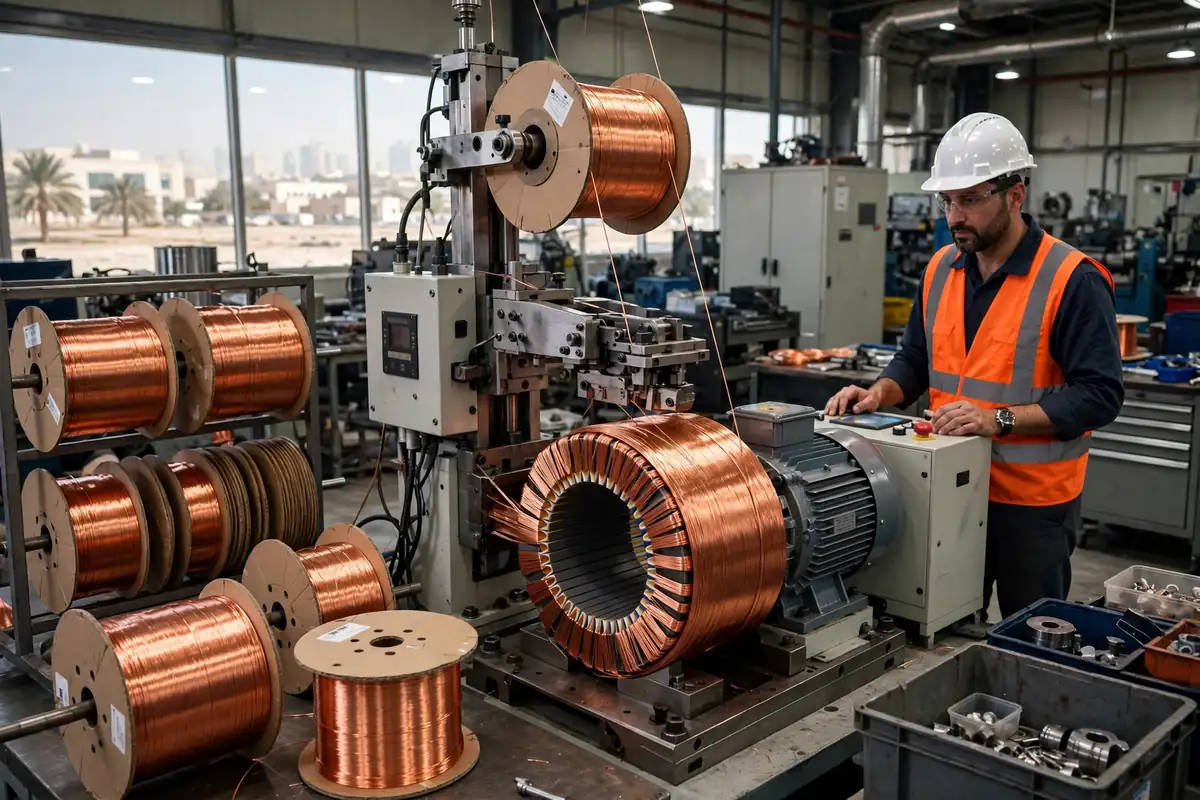
The machine behind the job depends on the coil type and production volume. Automatic coil winding machines handle high-volume, repeatable work: they wind precise layers at high speed with programmable turn counts, tension control, and automatic wire guiding. They are common in factories producing motor stators, transformer coils, and solenoid valves. Semi-automatic winders combine machine-driven winding with manual loading and finishing, giving smaller workshops flexibility for varied jobs without the cost of full automation. Toroidal winding machines wind wire around ring-shaped cores for transformers, inductors, and current sensors — work that is difficult to do neatly by hand. When comparing workshops, ask what machines they run: a shop equipped for both automatic and manual winding can usually take on a wider range of jobs and deliver more consistent results than one relying on hand winding alone.
Industries Served
Coil winding supports almost every sector that uses powered equipment. In HVAC, rewound fan, blower, and compressor motors keep buildings cool through the long summer. Pumps in buildings, farms, and water treatment plants depend on rewound submersible and centrifugal pump motors. Manufacturing plants need winding services for production machinery, conveyors, machine tools, and metal fabrication workshops — equipment closely related to the wider industrial machinery sector. Many winding workshops also work with industrial engineering firms on installation, alignment, and commissioning. The oil and gas industry relies on explosion-proof and heavy-duty motor rewinding for rigs, refineries, and processing plants, where downtime is expensive and safety standards are strict. Construction fleets often pair rewinding with heavy equipment repair to keep excavators and loaders working.
Costs and Factors
Coil winding costs in the UAE vary with motor size, winding type, wire material, and urgency. Small single-phase motors are usually the cheapest to rewind, while large three-phase industrial motors cost more because they use more copper and labour. Copper wire costs more than aluminium but conducts better and lasts longer, so most workshops recommend copper for motors that run continuously. Emergency or same-day jobs carry a premium. Other cost factors include bearing replacement, shaft repair, varnishing, and testing. Always ask for a written quotation that separates rewinding from parts and labour, and compare it with the price of a new motor — rewinding usually wins for larger motors, while replacement can make more sense for small, low-cost units.
Choosing a Service Provider
Choose a workshop with experience in your equipment type, and ask to see its testing setup. A good provider tests every rewind: insulation resistance, surge testing, no-load current, and a full-load run where possible. Ask about the insulation class used — Class F or H insulation handles the UAE heat better than lower classes — and about the varnish and baking process, which seals the windings against moisture and dust. Check whether the workshop offers a warranty on rewound motors, typically three to twelve months, and whether it documents test results. Also confirm practical details: pickup and delivery across your emirate, turnaround time, and whether it stocks common bearings and seals so a single repair visit can cover related wear parts such as hydraulic seals.
Maintenance Tips
Regular maintenance extends the life of any wound coil. Keep motors clean and ventilated, because dust and blocked cooling fins cause overheating — the leading cause of winding failure. Check bearings and alignment, since vibration damages insulation over time. Monitor current draw and temperature, and investigate any burning smell, humming, or tripped protection quickly rather than restarting a struggling motor. For standby generators, run them under load periodically and keep a maintenance schedule, so a neglected generator does not fail when it is needed most. Scheduled servicing costs far less than emergency rewinding. For broader electrical work, our guide to electronics and electrical services in the UAE covers shops and services across the Emirates.