Shell and Tube Heat Exchangers in UAE are workhorses behind much of the country’s industry. From refineries in Abu Dhabi to desalination plants on the coast and district cooling systems in Dubai, these robust pieces of industrial machinery move heat between two fluids without mixing them. If you are specifying equipment for a new plant, replacing an ageing exchanger, or simply comparing options, this guide explains how shell and tube heat exchangers work, which type suits your duty, what they cost in the UAE, and how to keep them running efficiently.
How Shell and Tube Heat Exchangers Work
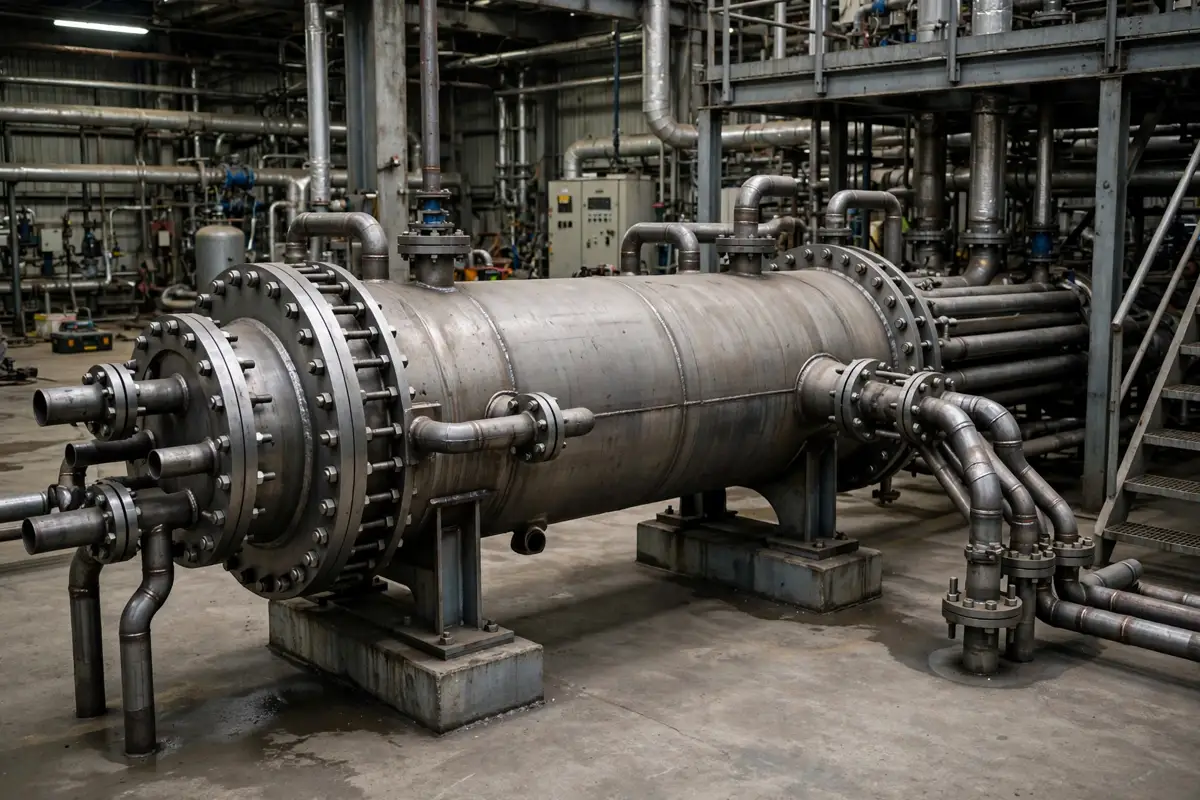
A shell and tube heat exchanger has a simple idea at its core. One fluid flows through a bundle of tubes, while a second fluid flows around those tubes inside a larger cylindrical shell. Heat passes through the tube walls from the hotter fluid to the cooler one. Baffles inside the shell direct the shell-side flow across the tubes, improving heat transfer and supporting the bundle. Because the two streams never meet, the design suits high-pressure, high-temperature and corrosive duties where mixing would be unsafe or costly.
In the UAE, this reliability matters. Summer ambient temperatures, saline cooling water and round-the-clock operation put equipment under constant stress. A well-specified shell and tube unit handles those conditions, tolerates fouling better than many compact designs, and can be opened, cleaned and repaired rather than replaced. That serviceability is a major reason engineers across the Emirates still choose it for critical heating and cooling duties.
Types of Shell and Tube Heat Exchangers
There are three main configurations. The right choice depends on thermal expansion, cleaning access, pressure and budget.
Fixed Tubesheet
Fixed tubesheet exchangers have both tube sheets welded to the shell. They are compact, economical and suitable for clean services with limited temperature differences between shell and tube fluids. Because the bundle cannot be removed, mechanical cleaning of the shell side is difficult, so they suit duties where fouling is low. They are common in straightforward heating and cooling applications in UAE plants.
U-Tube
U-tube exchangers use tubes bent into a U shape, so only one tube sheet is needed and the bundle can expand freely. That makes them a good fit for large temperature differences and thermal cycling. The bundle can be removed for shell-side cleaning, although cleaning inside the curved U-bends is harder. They offer a practical balance of flexibility, reliability and cost for many oil, gas and petrochemical duties.
Floating Head
Floating head exchangers let one tube sheet float inside the shell, absorbing thermal expansion while allowing full bundle removal. They are the easiest type to clean and inspect, and they handle high pressures and large temperature differences. They cost more and have more complex seals, but for fouling, corrosive or high-temperature services in the UAE, the easier maintenance often justifies the higher upfront price.
Materials for UAE Conditions
Material selection decides lifespan in UAE conditions. Carbon steel is the economical choice for non-corrosive duties such as clean water, steam and oil heating. Stainless steel grades 304 and 316 resist corrosion and suit food processing, pharmaceutical and many chemical services. For seawater, brine and aggressive chemicals, titanium or duplex stainless tubes resist pitting and chloride attack far better. Pair the tube material with a compatible shell made by sheet metal fabrication, baffles and gaskets, and check that your choice suits local water chemistry if you use seawater or recycled water from wastewater treatment for cooling.
Industries Served in the UAE
Shell and tube heat exchangers serve almost every heavy industry in the UAE:
- Oil and gas — crude preheating, gas cooling, condensate handling and refinery heat recovery.
- Petrochemical — reactor heating and cooling, distillation condensers and product coolers.
- Desalination — brine heaters, distillate coolers and heat recovery in thermal desalination plants.
- HVAC and district cooling — chilled water, condenser water and heat recovery in large buildings and cooling plants.
- Food processing — pasteurisation, sterilisation and temperature control where hygiene and cleanability matter.
They also appear in power generation, marine cooling and chemical plants across Abu Dhabi, Dubai, Sharjah and the Northern Emirates.
Sizing and Selection
Correct sizing starts with the duty: flow rates, inlet and outlet temperatures, allowable pressure drop and the properties of both fluids. Engineers then choose the configuration, tube diameter and length, baffle spacing and number of passes to hit the target heat transfer without excessive pressure loss or vibration. Oversizing wastes money and can cause low velocities that accelerate fouling, while undersizing leaves you short on capacity on the hottest days.
Ask suppliers for thermal calculations, pressure-drop figures, material certificates and a fouling allowance suited to your water quality. If you are replacing an existing unit, share the original datasheet, operating logs and any vibration or leakage history. For new projects, confirm space, lifting access and cleaning clearance early, because a floating-head unit needs more room for bundle removal than a fixed tubesheet unit.
Maintenance and Cleaning
Regular maintenance keeps efficiency high and prevents unplanned shutdowns. Inspect gaskets, hydraulic seals, bolts and tube joints for leaks, monitor pressure drop and outlet temperatures for signs of fouling, and clean the tube side mechanically or chemically when performance drops. For shell-side fouling, a removable bundle makes cleaning far easier. In coastal plants, watch for chloride corrosion and scaling, use proper industrial water treatment for cooling water, and keep a spare gasket and tube-plug kit on site so minor leaks can be fixed without waiting for parts.
Costs in AED
Costs in the UAE vary widely with size, materials and pressure rating. As a guide, small carbon-steel units for light commercial or HVAC duties often start from around AED 8,000 to AED 25,000. Mid-size industrial stainless-steel exchangers commonly fall between AED 30,000 and AED 120,000, while large, custom or titanium units for oil, gas and desalination can exceed AED 250,000. Add installation, piping, industrial valves, insulation, controls and commissioning to the equipment price, and get at least three written quotations with the same datasheet so you compare like for like.
Suppliers in the UAE
When choosing suppliers in UAE, look for ASME and TEMA compliance, in-house metal fabrication and testing, and local after-sales support in Dubai, Abu Dhabi or Sharjah. Check references for similar duties, confirm delivery times and warranty terms, and ask whether the supplier offers cleaning, retubing and spare parts. With the right type, materials and maintenance plan, a shell and tube heat exchanger will deliver reliable, efficient service for many years in demanding UAE conditions.