Sheet metal fabrication in UAE supports everything from gleaming tower facades in Dubai to precision brackets in an Abu Dhabi plant. Whether you need a single prototype or thousands of identical parts, a good fabrication workshop turns flat sheets of steel, aluminium, or stainless steel into finished components that fit, function, and last in the region’s heat, humidity, and dust. This guide covers processes, materials, costs, and quality checks.
What is sheet metal fabrication?
Sheet metal fabrication is the process of cutting, bending, forming, joining, and finishing thin metal sheets into parts and assemblies. Most workshops in the UAE work with sheets from under 1 mm to around 12 mm thick, depending on the job. A bracket may start as a laser-cut blank, get bent on a press brake, then welded, ground smooth, and powder-coated. A larger assembly, such as an HVAC duct run or an equipment enclosure, may combine dozens of such parts with fasteners, gaskets, hinges, and seals.
Core services offered by UAE fabrication workshops
Most UAE workshops offer a similar core menu. Knowing each service helps you choose the right process.
- Laser cutting uses a focused beam to cut precise profiles, holes, and slots in steel, aluminium, and stainless steel. It suits flat parts, brackets, panels, and decorative screens, and it holds tight tolerances on thin to medium sheets.
- CNC punching stamps holes, louvers, and forms quickly, making it economical for panels with many repeated holes, such as ventilation grilles and electrical enclosures.
- Press brakes bend sheet metal into channels, angles, trays, and enclosures. Accurate bending depends on the right tooling, bend allowances, and grain direction, so share your drawings and tolerances early.
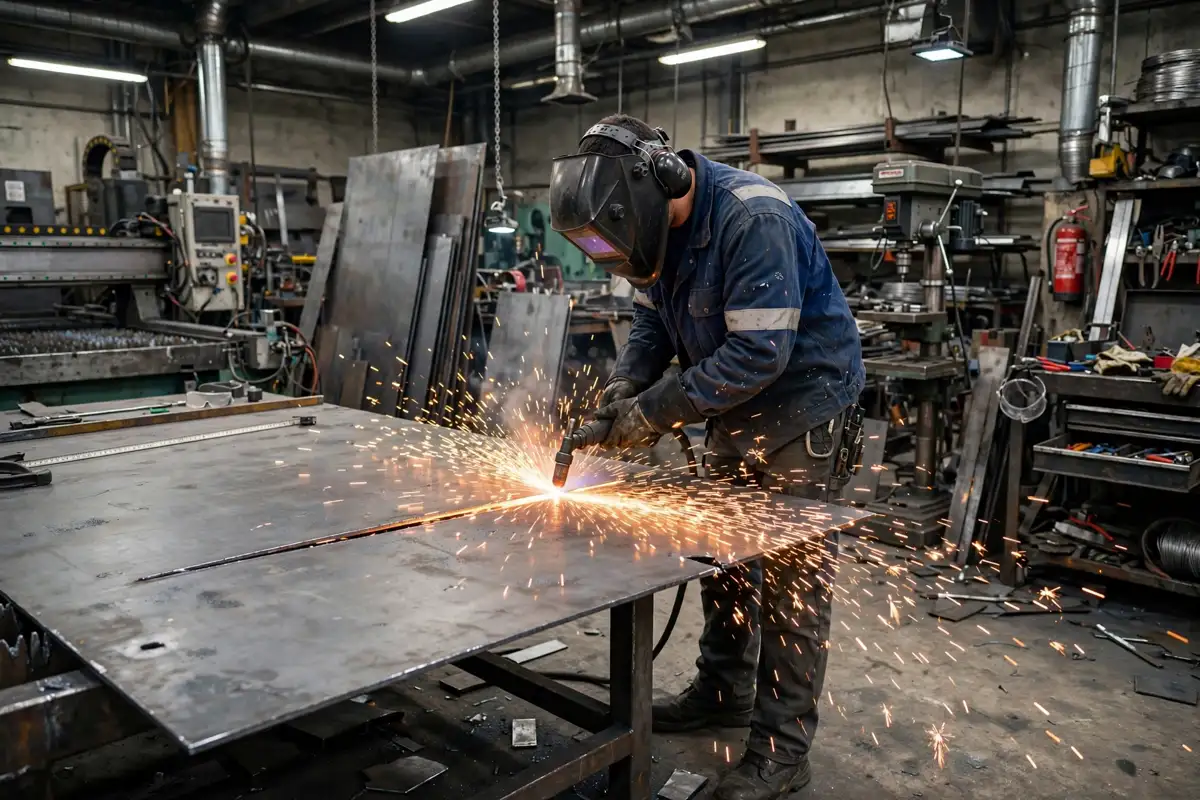
- Welding joins fabricated parts into frames, tanks, ducts, and assemblies. Common methods include MIG, TIG, and spot welding. TIG gives the cleanest finish on stainless steel and aluminium, while MIG suits heavier structural work.
- Finishing protects metal from corrosion and improves appearance. Options include powder coating, anodising, galvanising, brushing, polishing, and painting. In the UAE climate, a good finish is not cosmetic alone; it extends service life.
Materials used in sheet metal fabrication
Material choice affects strength, weight, corrosion resistance, and cost. The three workhorses are carbon steel, aluminium, and stainless steel.
- Carbon steel is strong, affordable, and easy to weld. It suits frames, brackets, enclosures, and structural parts, but it needs coating or galvanising to resist rust in coastal humidity.
- Aluminium is light, naturally corrosion-resistant, and easy to form. It is a popular choice for signage, facades, HVAC components, and transport parts where weight matters.
- Stainless steel resists corrosion and looks clean, which makes it ideal for food equipment, medical fittings, kitchens, and architectural trim. It costs more and needs skilled welding and finishing.
Industries served
Fabricated sheet metal appears in almost every UAE sector. Workshops regularly supply:
- Construction. Construction teams use fabricated steel for cladding, staircases, balustrades, cable trays, door frames, and structural supports. If your project involves a contractor, check how leading construction companies in Business Bay coordinate fabrication with site schedules.
- HVAC. HVAC contractors need ducts, dampers, grilles, and plant-room enclosures. Large fans and ventilation equipment, including HVLS industrial fans in Dubai, often sit alongside fabricated ductwork in warehouses and malls.
- Automotive. The automotive sector needs brackets, guards, trays, and custom panels. Growth in the automotive industry in UAE keeps demand steady for short runs and replacement parts.
- Signage and interiors. Retail and hospitality projects need illuminated signs, display frames, counters, and kitchen canopies.
- Industrial and infrastructure. Factories, utilities, and transport projects use enclosures, control panels, tanks, and guards. Mechanical engineering contractors in the UAE often bundle fabrication with installation and maintenance.
- Related reading. For a broader overview, see this guide to metal fabrication in the UAE, which covers related processes and suppliers.
How to choose a fabrication workshop in the UAE
The right workshop matters more than the lowest quote. Use this checklist in Dubai, Abu Dhabi, and Sharjah:
- Ask for recent work similar to yours, with photos, tolerances, and references. A workshop that has made your part type before will foresee problems faster.
- Confirm equipment: laser cutters, press brakes, CNC punch presses, and welding bays. The right mix shortens lead times and reduces outsourcing.
- Check materials and traceability. Ask whether the supplier stocks certified sheets and can provide mill certificates for structural or food-grade work.
- Agree drawings, tolerances, finishes, and inspection steps in writing before production. A clear drawing pack prevents most rework.
- Ask about industrial valves and fittings early if your assembly includes fluid lines, so mating parts and threads match.
- Visit the workshop if the order is large. Clean, organised premises and calibrated measuring tools are a good sign of consistent quality.
Costs in AED
Costs vary with material, thickness, quantity, complexity, and finish, so treat any price below as a planning range, not a quotation. For simple brackets and panels, small jobs often start from around AED 150 to AED 600 per piece, while larger enclosures, ducts, and custom assemblies commonly fall between AED 800 and AED 5,000 each. Prototype and one-off work costs more per unit because setup, programming, and tooling are spread across a single part. Laser cutting is usually charged by cutting time and material, bending by the number of bends, and welding by labour time. Powder coating and other finishes add roughly AED 30 to AED 150 per square metre, depending on colour and specification. Always ask for a written quote that separates material, labour, finishing, delivery, and VAT.
Lead times
Lead times depend on complexity and workshop load. Simple cut-and-bend parts can be ready in 2 to 4 working days. Standard enclosures and ductwork usually take 1 to 2 weeks. Complex assemblies with welding, coating, and inspection may need 3 to 4 weeks. Allow extra time during peak construction periods and public holidays, and confirm delivery, installation, and site access in advance. If your project connects to wider infrastructure work, such as Etihad Rail, build buffer time into the schedule.
Quality standards and checks
Ask suppliers which standards they follow for welding, coatings, and dimensional checks. Good workshops check first articles against drawings, measure critical dimensions, and keep records for repeat orders. For load-bearing or safety-critical parts, request inspection reports and material certificates. Check weld appearance, edge finish, hole alignment, and coating adhesion before you accept delivery, and agree in advance how defects will be corrected.