For engineers weighing up PTFE coatings in UAE production and maintenance, the appeal is easy to understand: a dry, non-stick surface that resists heat, chemicals and corrosion while allowing parts to release cleanly and move with less friction. PTFE, widely known by the brand name Teflon, is used on everything from food processing equipment and packaging machinery in Dubai and Sharjah to valves, moulds, chutes and fasteners serving oil, gas and manufacturing plants across the Emirates. It is not a miracle finish for every job, however. This guide explains where PTFE coatings perform best, how they are applied, what to specify, and how to judge a UAE coating provider before you commit valuable components.
What PTFE Coating Is and Why It Behaves Differently
PTFE stands for polytetrafluoroethylene, a fluoropolymer with an unusual combination of properties. It has a very low coefficient of friction, so surfaces coated with it feel slippery and parts stick far less than they would to bare metal. It is chemically inert to most industrial chemicals, it tolerates a wide temperature range in service, and it does not absorb water. It is also an electrical insulator. Applied as an industrial coating, PTFE is usually built up in thin layers, often combined with primer and sometimes reinforced or blended with other resins to improve wear resistance, hardness or corrosion protection for a specific duty.
That blend point matters. Pure PTFE is relatively soft, so for parts that see abrasion, sliding contact or frequent cleaning, applicators may recommend a PTFE-based system engineered for that environment rather than the softest, most non-stick option. Food contact work needs coatings and processes suitable for food use. Chemical plant work may prioritise a thicker, pinhole-checked system for corrosion protection. The right question is not simply whether a part can be PTFE coated, but which coating system, at what thickness, on what substrate, will survive your actual process.
PTFE should also not be confused with decorative or protective paint. If your need is mainly appearance or general metal protection, start with our guide to painting of metals in the UAE to compare conventional coating routes, then return to PTFE when you specifically need release, low friction or chemical resistance that paint cannot provide.
Common Industrial Uses Across the Emirates
Food and beverage production is one of the clearest uses. Coated trays, moulds, cutters, rollers and hoppers release dough, confectionery and processed foods more cleanly, which speeds cleaning and reduces product waste. Packaging machinery benefits in the same way, with sealing jaws, guides and chutes resisting sticky films and adhesives. In bakeries and food factories, faster changeovers and less aggressive cleaning also mean less downtime and less damage to equipment surfaces over time.
In general manufacturing, PTFE coatings are used on mould tools for plastics and rubber, on release surfaces for composites, and on slides, chutes and bins where powders or granules must flow freely. In chemical processing and utilities, coated valves, pump parts, fasteners and vessels can gain resistance to aggressive media and become easier to strip and maintain. Fasteners are a quiet success story: coated bolts are less likely to gall or seize, torque behaves more consistently, and maintenance teams can undo joints later without cutting or heating.
These applications often sit alongside other plant equipment covered in our overview of industrial machinery in the UAE, where coating choices affect cleaning, maintenance intervals and spare parts planning. Think of PTFE as part of your maintenance strategy, not just a finish. A coated spare kept ready for a critical mould or roller can turn a long stoppage into a short, planned swap.
How PTFE Coatings Are Applied: Preparation Is Everything
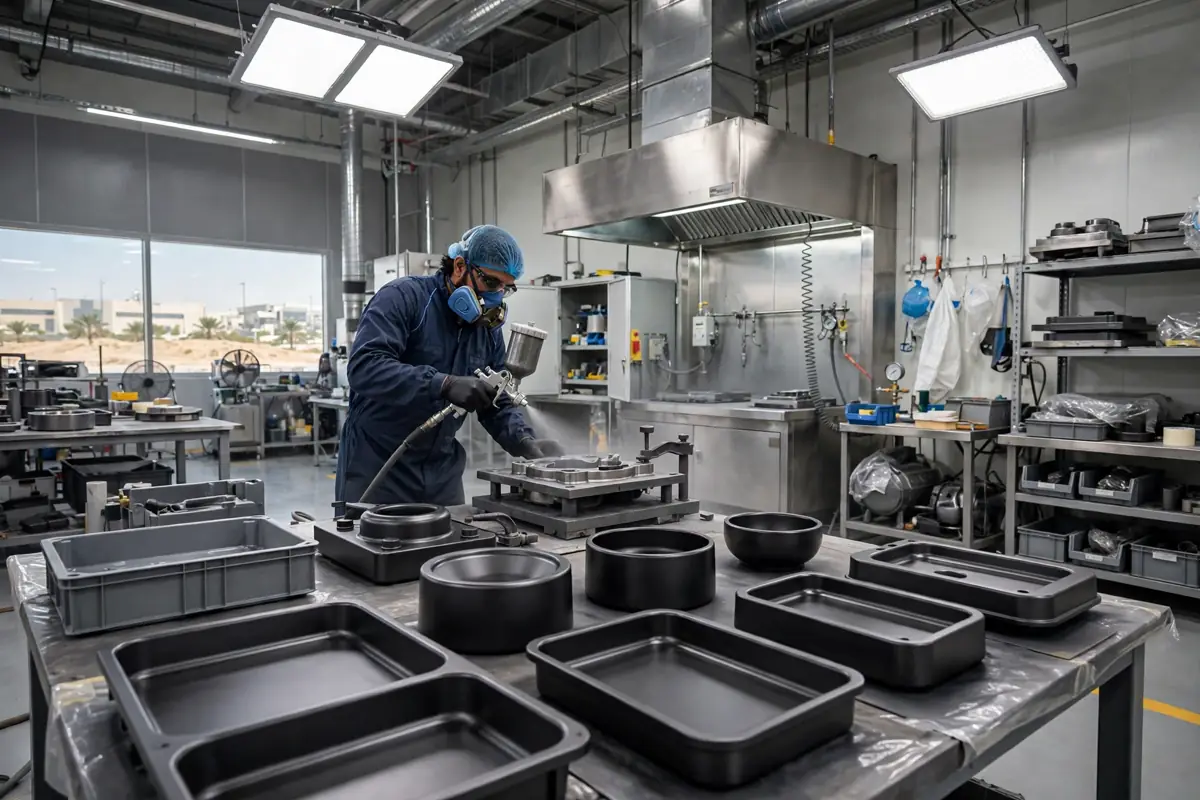
Good adhesion depends overwhelmingly on preparation. Components are degreased, often grit blasted to a clean, profiled surface, and masked where coating is not wanted, such as threads that must keep a precise fit or sealing faces with tight tolerances. Primer and build coats are then sprayed in controlled passes and cured at high temperature in an oven, with each coat checked for coverage and thickness. Final inspection should include thickness readings, adhesion checks where appropriate, visual examination for pinholes, runs or contamination, and for corrosion protection work, holiday or spark testing to find discontinuities.
Substrate matters. PTFE systems are commonly applied to carbon steel, stainless steel, aluminium and some other metals, but each needs its own preparation and cure care. Thin sections can distort if handled carelessly, castings can outgas and cause defects if not pre-treated, and previously coated or contaminated parts need full stripping before recoating. Tell your applicator what the part is made from, what it has carried, and what temperatures it sees in service. Hidden oils, silicone residues and old coatings are frequent causes of failure that only show up after the part returns to work.
Where PTFE is being considered alongside floor or plant protection systems, it is worth comparing duties carefully. Our guide to epoxy flooring in the UAE covers a very different coating family designed for floors and heavy traffic, and it underlines the same lesson: preparation, correct product selection and proper curing decide service life far more than brand names.
Benefits, Limits and When to Choose an Alternative
The benefits, when the coating is matched to the job, are practical and measurable in daily operation even without quoting figures: easier release, quicker cleaning, less product build-up, reduced sticking and galling, good chemical resistance, and stable performance in hot processes within the coating limits. For maintenance teams, easier cleaning means gentler cleaning. Less scraping and fewer aggressive chemicals help both the coating and the base equipment last longer.
The limits deserve equal honesty. PTFE coatings are thin films, not armour. Sharp edges, metal-to-metal impact, abrasive slurries and careless handling with tools will cut or wear through them. They are not the right answer for structural corrosion protection on their own in every environment, nor for parts that exceed their temperature limits or need a hard, load-bearing surface. In high-wear duties a different system, such as a ceramic, carbide or specialist polymer coating, or a PTFE blend designed for wear, may serve better. A trustworthy applicator will tell you when PTFE is the wrong choice and explain the alternative, rather than coating everything you send.
Material choice for the underlying part also affects results. Our resource on stainless steel in the UAE explains grades and corrosion behaviour that influence whether you need coating for release, for protection, or for both. Similarly, if your process chemicals are changing, suppliers listed through our guide to chemical distributors in the UAE can confirm compatibility information for the media involved, which your applicator should then check against the coating system data sheet.
Specifying the Job and Choosing a UAE Applicator
A clear specification prevents most disputes. State the substrate, dimensions and weight, the coating system or performance you require, target thickness range, areas to mask, food contact or other compliance needs, colour if relevant, inspection requirements, and the service temperature and chemicals. Provide drawings where tolerances matter, and send a sample or trial part first for critical or high-volume work. Agree how parts should be packed for transport, because a freshly coated surface can be damaged by poor wrapping, stacking or strapping before it ever reaches your plant.
When comparing UAE applicators, visit the facility if you can. Look for clean preparation areas, controlled spraying, proper ovens with reliable temperature control, thickness gauges and inspection records, and staff who ask detailed questions about your process. Ask what happens if a coating fails early, how recoating and stripping are priced, and what lead times look like during busy shutdown periods. Fabrication and repair partners, such as those covered in our guide to metal fabrication in the UAE, often work closely with applicators, so coordinated planning between fabricator and coater helps ensure edges, welds and drainage details are coating-friendly from the start.
Price comparisons only make sense on the same specification. A cheaper quote that uses fewer coats, less preparation or no pinhole testing is not the same product. Ask each bidder to confirm preparation method, number of coats, cured thickness and inspection in writing. For repeat work, keep a coating log for each critical part: date, applicator, system, thickness and service history. That record makes reordering simple and helps you spot whether a change in process, cleaning chemical or operating temperature is shortening coating life.
Used thoughtfully, PTFE coatings solve sticky, corrosive and high-friction problems that cost UAE plants time every single shift. Match the system to the duty, insist on meticulous preparation and inspection, handle coated parts with care, and be honest about the limits of a thin fluoropolymer film. On the right components, the result is cleaner production, calmer maintenance and equipment that comes apart and goes back together the way it should.