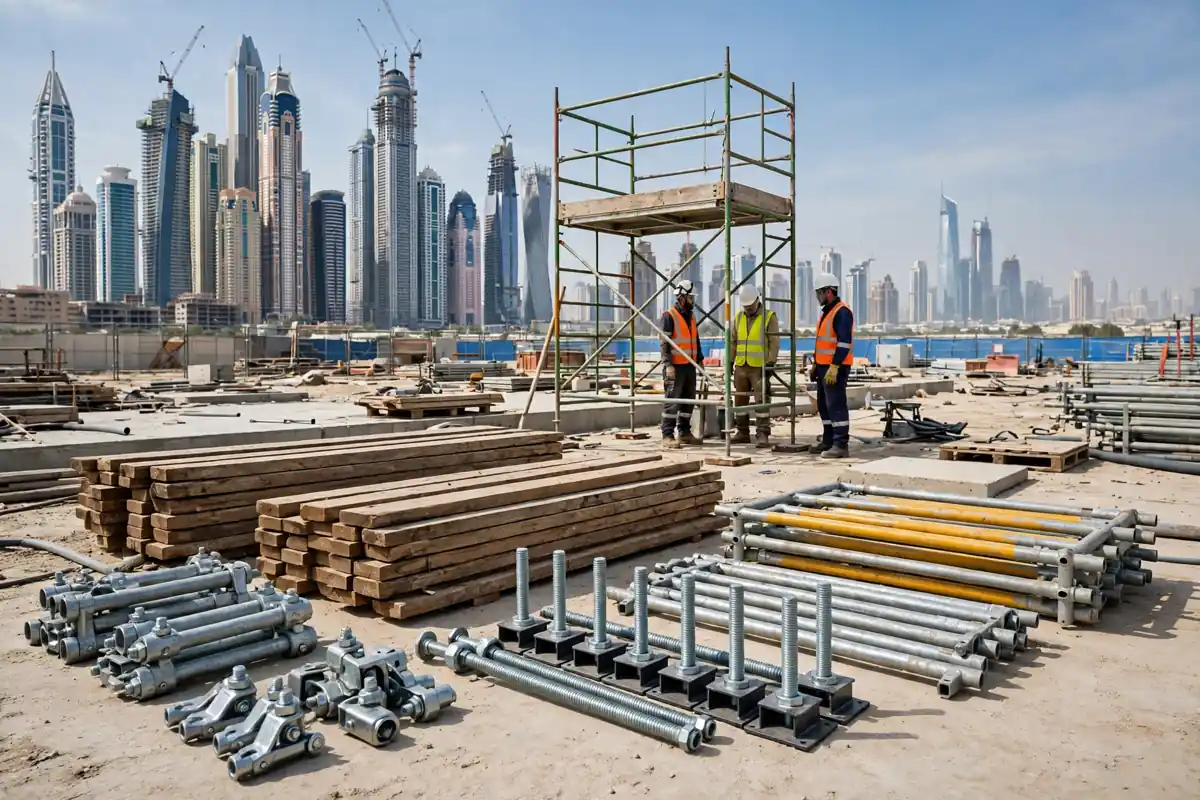
Choosing the right scaffolding accessories in UAE projects is a safety decision first and a buying decision second. The frame or tube may get most of the attention, but it is the couplers, boards, ladders, castors, ties and guardrails that hold the structure together, give workers secure footing, and keep loads and people where they should be. From high-rise work in Dubai to maintenance shutdowns in Abu Dhabi and villa projects in Sharjah, the same rules apply: buy compatible, certified components, inspect them properly, and replace anything damaged without debate. This guide explains the main accessory types, the safety checks that matter in UAE heat and coastal conditions, and how to choose suppliers who support you after delivery.
The Core Accessories Every Scaffold Needs
Couplers and fittings connect tubes and are the backbone of tube-and-fitting scaffolds. Right-angle couplers join standards to ledgers and transoms, swivel couplers allow angled bracing, and sleeve and joint pins extend tubes safely. Each coupler must match the tube diameter, close fully, and grip without slipping. On system scaffolds, the equivalent role is played by wedges, pins, rosettes and locking devices designed specifically for that system. Never mix components from different systems unless the manufacturer confirms compatibility in writing, because a pin that almost fits is a failure waiting to happen.
Base jacks, base plates and sole boards spread the load at ground level and allow careful levelling, which is especially important on uneven or sandy ground. Adjustable jacks should not be over-extended beyond the maker limits, and timber sole boards should be sound, flat and large enough for the ground conditions. At the top of the structure, guardrails, mid-rails, toe boards and brick guards protect people working on the platform and people below from falling tools and materials. If any of those protective pieces are missing, the scaffold is not complete, however strong the frame feels.
Access is another essential category. Ladder clamps, secured ladders, stair towers and access gates give workers a safe route up and down without climbing the frame. Platforms themselves, whether timber scaffold boards or steel decks, must be fully boarded where work is happening, supported at the correct spans, and secured against uplift and displacement in windy conditions. For context on how scaffolding fits into wider site planning, see our guide to building construction in the UAE.
Types of Scaffolds and the Accessories That Go With Them
Different scaffolds need different accessory kits. Independent tied scaffolds, commonly used on building facades, rely heavily on ties, reveal fittings and anchors that connect the structure to the building at planned intervals. Mobile access towers rely on castor wheels with brakes, stabilisers and outriggers that must be deployed exactly as instructed, plus trapdoor platforms for safe internal access. Suspended scaffolds and mast climbers have their own specialist components and inspection regimes and should only be supplied and erected by specialist firms.
System scaffolds popular on large UAE projects use ledgers, standards, diagonal braces and steel decks that lock together quickly. Their accessories include tie bars, cantilever brackets, loading bays and beam clamps for bridging openings. Cuplock, ringlock and frame systems each have dedicated parts, so keep systems separated in your yard, labelled clearly, and stored so crews cannot accidentally grab the wrong fitting under time pressure. On complex commercial jobs, such as those run by construction companies in Business Bay and other dense Dubai districts, space for storage and delivery is tight, so a tidy, well-labelled accessory store directly improves both safety and programme.
Do not forget the smaller but critical items: debris netting and sheeting fixings, gin wheels and ropes for light lifting where permitted, signage and scaffold tags, and edge protection for loading areas. List these on your order from the start rather than improvising on site.
Materials, Corrosion and UAE Weather Conditions
Most scaffold tubes and fittings are steel, often galvanised to resist corrosion, while boards may be timber or steel and decks are usually steel or aluminium. The UAE climate tests all of them. Coastal humidity and salt air around Dubai, Abu Dhabi and the Northern Emirates accelerate rust, intense sun degrades timber and plastics, and fine sand works into threads and moving parts. Galvanised fittings, properly stored off the ground and under cover, will last far longer than bare steel left in an open yard.
Inspect timber boards for splits, knots that weaken the board, warping, oil or concrete contamination, and ends that have been cut back so often that overhang rules can no longer be met. Steel decks should be checked for bent edges, damaged locking hooks and surfaces worn smooth. Castor wheels need brakes that actually hold and tyres or rims free from cracks and flat spots. Base jack threads should be cleaned and lightly maintained so adjustment stays smooth and accurate.
Materials planning helps here too. Our overview of building materials in the UAE explains how storage, handling and climate affect quality across a project, and the same principles apply to scaffold stock: keep it dry, stacked flat, separated by type, and rotated so older stock is inspected and used first. Good yards make good scaffolds.
Safety, Inspection and Competent Use on Site
A scaffold is only as safe as its erection, alteration and inspection. In the UAE, scaffolds should be erected, altered and dismantled by trained, competent scaffolders under supervision, following the manufacturer instructions for system scaffolds and a proper design for complex tube-and-fitting structures. A scaffold tag system at the access point, updated after erection and after each inspection, tells users whether the structure is safe to use. Inspections are needed before first use, at regular intervals while in use, and after any event that could affect stability, such as high winds, impact by a vehicle, or a significant alteration.
Daily user checks are simple and powerful. Before climbing, workers should confirm the tag is in date, access is complete, platforms are fully boarded, guardrails and toe boards are in place, ties have not been removed, and there is no visible damage or overload of materials. Ties deserve special emphasis: they are often removed by follow-on trades to make work easier, which quietly makes the whole structure unsafe. Site rules should state plainly that only scaffolders may alter any part of the scaffold, including ties, ledgers and bracing.
Engineering oversight matters on larger or non-standard structures. Firms listed among civil engineering contractors in the UAE will be familiar with temporary works design, load checks and tie testing, and involving that expertise early prevents redesigns on site. Combine that with general site safety equipment, covered in our guide to road safety products in the UAE for barriers, signage and pedestrian protection around scaffold zones, especially where scaffolds stand beside public footpaths and roads.
Buying, Hiring and Managing Accessories in the UAE
You can buy accessories outright, hire a complete scaffold package, or combine both by owning core stock and hiring specialist items. Buying suits contractors with steady work and a proper yard, inspection routine and storage. Hiring suits short projects and transfers much of the maintenance and replacement burden to the hire company, provided the hire terms are clear about damage, loss and cleaning charges. Whichever route you choose, specify standards and compatibility in writing, ask for test certificates and manufacturer information for couplers and boards, and reject unmarked or visibly repaired fittings.
Accurate setting out reduces waste and rework. Crews using the equipment described in our guide to surveying equipment in the UAE can set base positions, levels and tie locations correctly the first time, which makes erection faster and inspections smoother. Keep an inventory of accessories by type and condition, not just a total scaffold count, so you know whether you actually have enough couplers, boards and ties for the next job. Shortages of small fittings are a common cause of dangerous improvisation.
For projects that also need site cabins, storage units or temporary facilities, our resource on prefabricated modular buildings in the UAE shows how temporary structures are planned alongside access and welfare. Coordinating scaffold deliveries with cabin placement and material laydown areas avoids blocked access and double handling.
Finally, agree delivery and collection logistics in advance: vehicle access, offloading space, stacking areas and return inspections. Photograph loads on arrival and departure, record counts of small fittings in bags or stillages, and settle discrepancies quickly while memories are fresh. Those simple habits protect both buyer and supplier.
Scaffolding accessories may look like small hardware, but on a UAE site they carry real loads, protect real people and decide whether a scaffold passes inspection or stops the job. Buy compatible, certified components, store them for a hot and coastal climate, inspect them on a clear schedule, and never allow damaged or missing parts to be worked around. With that discipline in place, your scaffolds will go up faster, stand safer, and come down without drama, project after project.