Blow moulding in UAE is a fast-growing part of the country’s plastics and packaging industry. From drinking-water bottles in Dubai to chemical drums in Sharjah and jerry cans in Ajman, hollow plastic containers made by blow moulding serve food and beverages, cleaning products, cosmetics, healthcare, agriculture, and industrial chemicals.
The UAE’s position as a manufacturing, re-export, and logistics hub makes it an attractive place to source blow-moulded products. Buyers can find local factories for large runs, traders who stock standard bottles, and specialist moulders who develop custom shapes. This guide explains how blow moulding works, what it can produce, which plastics are used, what it costs, and how to choose a supplier.
What Is Blow Moulding?
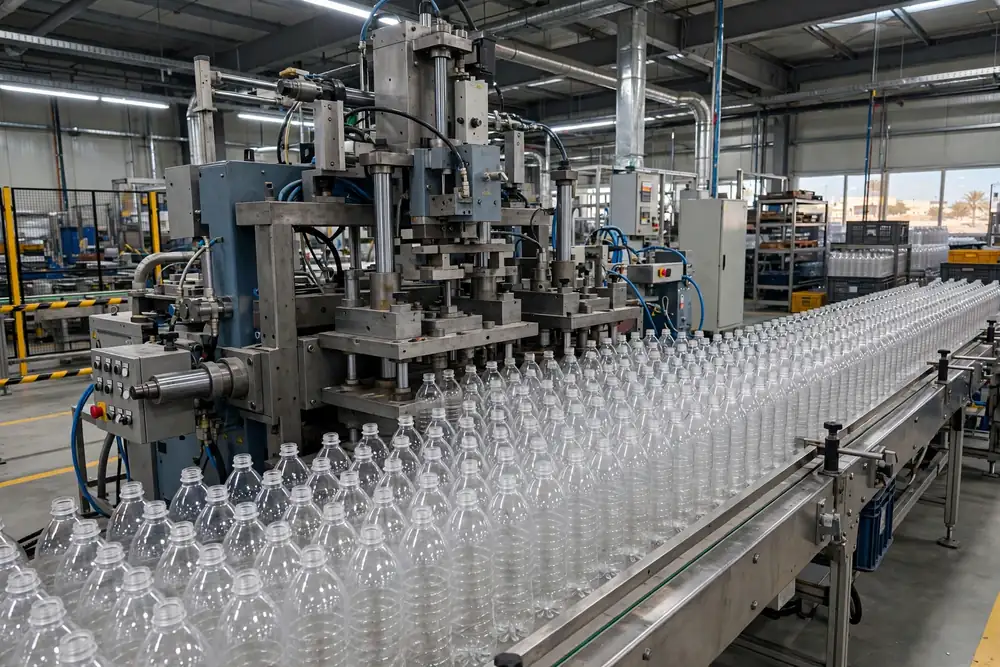
Blow moulding is a manufacturing process used to make hollow plastic parts. A heated plastic tube, called a parison, or a preform is placed inside a two-part mould. Compressed air then inflates the plastic until it takes the shape of the mould cavity. The part is cooled, the mould opens, and the finished container is trimmed and checked.
Because the process is designed for hollow shapes, it is ideal for bottles, jars, tanks, and drums. For a broader view of the sector, see our guide to industrial engineering in the UAE.
The Three Main Blow Moulding Processes
There are three main types of blow moulding. The right choice depends on the product, the plastic, the required finish, and the order volume.
1. Extrusion Blow Moulding (EBM)
Extrusion blow moulding is the most common method for larger containers. Molten plastic is extruded as a hollow tube, clamped in a mould, and blown into shape. It suits HDPE bottles, jerry cans, drums, and detergent containers. Tooling is generally less expensive than injection methods.
2. Injection Blow Moulding (IBM)
Injection blow moulding first injection-moulds a precise preform, then blows it into its final shape. It gives excellent accuracy and a clean, flash-free finish, which suits small pharmaceutical, cosmetic, and food containers where a neat neck matters. Mould costs are higher, so it is best for medium to high volumes.
3. Injection Stretch Blow Moulding (ISBM)
Injection stretch blow moulding stretches the preform both lengthwise and sideways before blowing. This stretching strengthens PET, improves clarity, and reduces weight. It is the standard process for water, soft-drink, juice, and edible-oil bottles. If you need bottles specifically, read our guide to plastic bottle making in the UAE.
Products Made by Blow Moulding in the UAE
Common products made by UAE factories include water, juice, and soft-drink bottles in PET; milk and dairy bottles in HDPE; detergent, bleach, and cleaning-product bottles; shampoo, lotion, and cosmetic bottles; jerry cans from 1 litre to 25 litres; industrial drums and chemical containers; water tanks; pharmaceutical bottles; spray bottles; and agricultural containers.
Cosmetic brands often need attractive, brand-specific bottles. Many work with factories that also serve the private label cosmetics industry in the UAE. Large industrial containers may also be paired with storage systems, including industrial water treatment in the UAE.
Plastics Used in Blow Moulding
PET (Polyethylene Terephthalate)
PET is clear, lightweight, strong, and widely recycled. It is the standard material for water and beverage bottles made by stretch blow moulding. PET gives a glossy, transparent finish that suits retail shelves, but it is less resistant to high temperatures than HDPE, so it is not ideal for hot-fill products without special treatment.
HDPE (High-Density Polyethylene)
HDPE is tough, chemical-resistant, and opaque. It is used for milk bottles, detergent bottles, jerry cans, drums, and chemical containers. HDPE handles impact well and is a good choice where strength matters more than transparency. It is also widely recycled in the UAE.
PP (Polypropylene)
PP is light, heat-resistant, and flexible. It is used for some pharmaceutical bottles, food containers, caps, and closures. PP tolerates higher temperatures than PET and HDPE, which makes it useful for hot-fill products. Confirm that your supplier has experience with this material.
Blow Moulding Manufacturers and Suppliers in the UAE
UAE blow moulding capacity is concentrated in the main industrial zones. Dubai has factories and packaging suppliers in Al Quoz, Dubai Industrial City, and Jebel Ali. Sharjah is a major base for plastics manufacturing, with clusters in its industrial areas and the Hamriyah Free Zone. Ajman hosts plastics factories serving the northern Emirates.
Suppliers fall into four groups: full manufacturers that run their own lines; mould makers that design and build moulds; traders and stockists that hold standard bottles, caps, and jerry cans; and contract packers that combine containers with filling, labelling, and packing. Many UAE suppliers also export to Saudi Arabia, Oman, Qatar, Kuwait, Bahrain, and East Africa. Agree delivery terms early if you plan to ship outside the country, including global transport from the UAE.
Costs, MOQs, and Lead Times in the UAE
Costs vary with material, size, mould complexity, decoration, and order volume. Standard stock bottles and jerry cans are the cheapest option because there is no new mould cost. Custom bottles cost more up front, but unit prices fall sharply as volumes rise. A simple custom mould for a small bottle may cost a few thousand dirhams, while a large, complex, multi-cavity mould can cost tens of thousands of dirhams.
Minimum order quantities (MOQs) also vary. Stock items may be available in cartons of a few hundred units. Custom moulded products commonly start at 10,000 to 50,000 units, and some high-speed lines prefer 100,000 units or more. Lead times for stock items can be a few days, while custom products usually take 4 to 10 weeks, including mould making, sampling, approvals, and production.
How to Choose a Blow Moulding Supplier in the UAE
Choosing the right supplier matters more than finding the lowest unit price. Before ordering, check experience with your product type, material and compliance certificates, mould ownership and maintenance, capacity and realistic lead times, quality control such as leak testing, decoration options, and transparent pricing covering mould cost, unit price, caps, packing, VAT, and delivery. A factory near your filler or warehouse can also reduce freight and damage.
Request physical samples before approving production, and test them with your actual product, cap, label, and filling line. Small differences in neck finish, weight, or wall thickness can cause leaks, label problems, or line stoppages.
Final Thoughts
Blow moulding in UAE offers local capacity, fast delivery, and export reach. Whether you need a standard PET water bottle, a custom HDPE detergent container, or a large industrial drum, the key steps are the same: choose the right process and plastic, agree on mould ownership and costs, confirm compliance, and test samples before committing to volume.