Every day, millions of plastic bottles move through the UAE — water bottles in supermarkets, juice bottles in cafés, detergent bottles in hypermarkets, and pharmaceutical bottles in pharmacies. Behind that steady demand sits a practical manufacturing opportunity: plastic bottle making in UAE. This guide explains how PET bottle production works, what machines cost in AED, which raw materials you need, how to set up a bottle making unit, and who buys the finished bottles.
Whether you plan a small water-bottle plant or a larger factory supplying beverages, dairy, cosmetics, and cleaning brands, the basics stay the same. You need the right machine, a reliable supply of PET preforms, space with power and water, the correct trade licence, and buyers who order regularly. Get those five pieces right, and a bottle unit can become a steady, long-term business.
How Plastic Bottle Manufacturing Works in the UAE
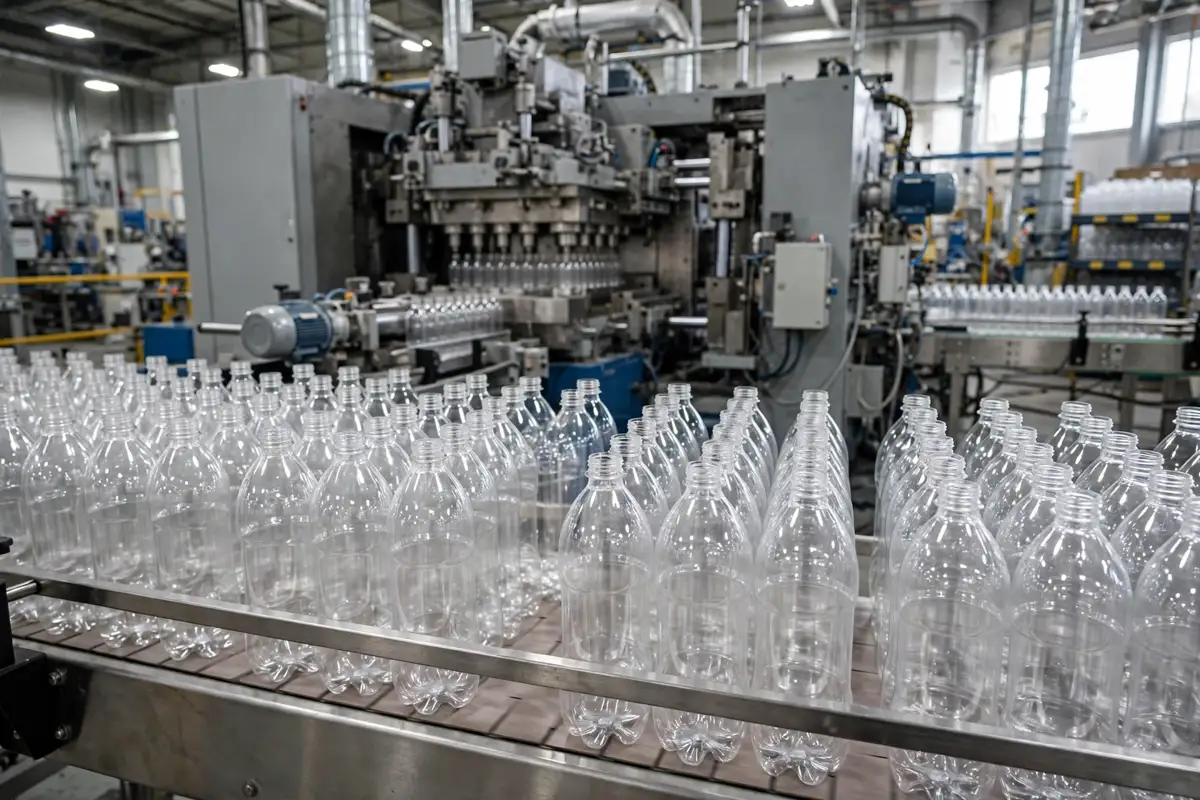
Most drinking-water and juice bottles in the UAE are made from PET, a clear, light, and food-safe plastic. Factories rarely start from raw plastic pellets for small and mid-size runs. Instead, they buy ready-made PET preforms — small test-tube-shaped pieces with a finished neck — and blow them into full-size bottles. This method is faster, cleaner, and easier to control than making bottles from scratch.
A typical line has four stages. First, preforms are heated evenly until they soften. Second, a blow moulding machine stretches the preform and blows compressed air into it, shaping it against a steel mould. Third, bottles are cooled, checked for leaks and wall thickness, and moved to filling or packing. Fourth, caps, labels, and cartons are added. A well-run line can produce thousands of bottles per hour with only a few operators.
PET Bottle Production: From Preform to Finished Bottle
PET preforms decide much of your bottle quality. A 19-gram preform suits a 330 ml water bottle, while a 28–32 gram preform suits a 500 ml bottle, and heavier preforms suit 1-litre and 1.5-litre bottles. The neck finish must match your caps exactly, or bottles will leak. Always test preforms from a new supplier on your own machine before ordering in bulk, and check clarity, weight consistency, and neck dimensions.
Blow moulding has two common setups. A semi-automatic machine suits startups: an operator loads preforms, the machine heats and blows them, and finished bottles drop out. Output is typically 300 to 1,000 bottles per hour. A fully automatic machine heats, blows, and ejects bottles without manual loading and can reach 2,000 to 12,000 bottles per hour, depending on cavities and bottle size. Choose capacity based on confirmed orders, not on the biggest machine you can afford.
Bottle Making Machines and Costs in AED
Machine prices in the UAE vary widely with speed, automation, and moulds. Use these ranges as planning figures and always get written quotations before committing: semi-automatic blow moulding machines often cost AED 25,000 to AED 90,000; fully automatic machines often cost AED 150,000 to AED 900,000 or more; bottle moulds typically cost AED 5,000 to AED 25,000 per design; and supporting equipment such as air compressors, chillers, and conveyors can add AED 30,000 to AED 120,000.
Do not judge a machine by price alone. Check bottles per hour on your actual preform and bottle size, electricity and air consumption, mould-change time, spare-parts availability, and after-sales service in the UAE. A slightly dearer machine with local service usually beats a cheaper import that sits idle while you wait for parts. Ask the supplier for a live trial with your preforms before you pay the balance.
Raw Materials: PET Preforms, Caps and Labels
Your main raw material is the PET preform, bought by weight and specification. Caps, usually HDPE or PP, must match the neck finish and seal tightly. Labels may be shrink sleeves, self-adhesive, or OPP wrap-around, depending on the look your buyer wants. Cartons, stretch film, and pallets complete the packing. Keep at least two suppliers for preforms and caps so a delay from one does not stop your whole line.
Setting Up a Bottle Making Unit in the UAE
Start with the licence. Bottle manufacturing is an industrial activity, so you will usually need an industrial licence from the relevant emirate or free-zone authority, plus approvals for your premises, power load, and any food-contact production. If you plan to sell across the UAE market, setting up a business in Dubai mainland is a common route. Other founders compare business setup in Sharjah, business setup in Ras Al Khaimah, and business setup in Fujairah before choosing a base.
Free zones can suit export-focused plants. The Ajman Free Zone offers industrial plots and warehousing with straightforward licensing, while founders who want flexible activities often review IFZA business activities before applying. Compare licence fees, warehouse rents, visa quotas, power capacity, and road access before signing. Industrial areas in Dubai, Sharjah, Ajman, and Ras Al Khaimah are popular because suppliers, transporters, and buyers are already nearby.
Buyers and Market for Plastic Bottles in the UAE
Demand comes from bottled-water brands, juice and dairy producers, edible-oil packers, cosmetics and personal-care brands, pharmaceutical companies, and cleaning-product makers. Many buyers want a regular monthly supply in one or two sizes, so winning even two or three steady contracts can keep a small plant busy. Offer samples, agree on quality checks, and quote delivered prices that include transport. Hotels, restaurants, and events also buy custom-labelled water bottles, which can carry better margins than plain bottles.
Recycling and Sustainability
PET is one of the most recycled plastics, and UAE buyers increasingly ask about recycled content and take-back. Design bottles to be light but strong, avoid mixed materials that complicate recycling, and keep your factory waste sorted. If you can offer bottles with recycled PET, clear labelling, and a simple collection story, you will stand out with supermarkets and brands that publish sustainability goals. Recycling is no longer an add-on; it is part of winning larger contracts.
Is a Bottle Making Unit Worth It?
A bottle making unit works best when you start with confirmed demand, a realistic machine size, and tight control of preform and power costs. Visit two or three working plants, speak to buyers before buying machines, and build a simple budget that covers rent, salaries, utilities, maintenance, and packing. With steady orders and careful quality control, plastic bottle making in UAE can grow from one machine into a dependable manufacturing business.