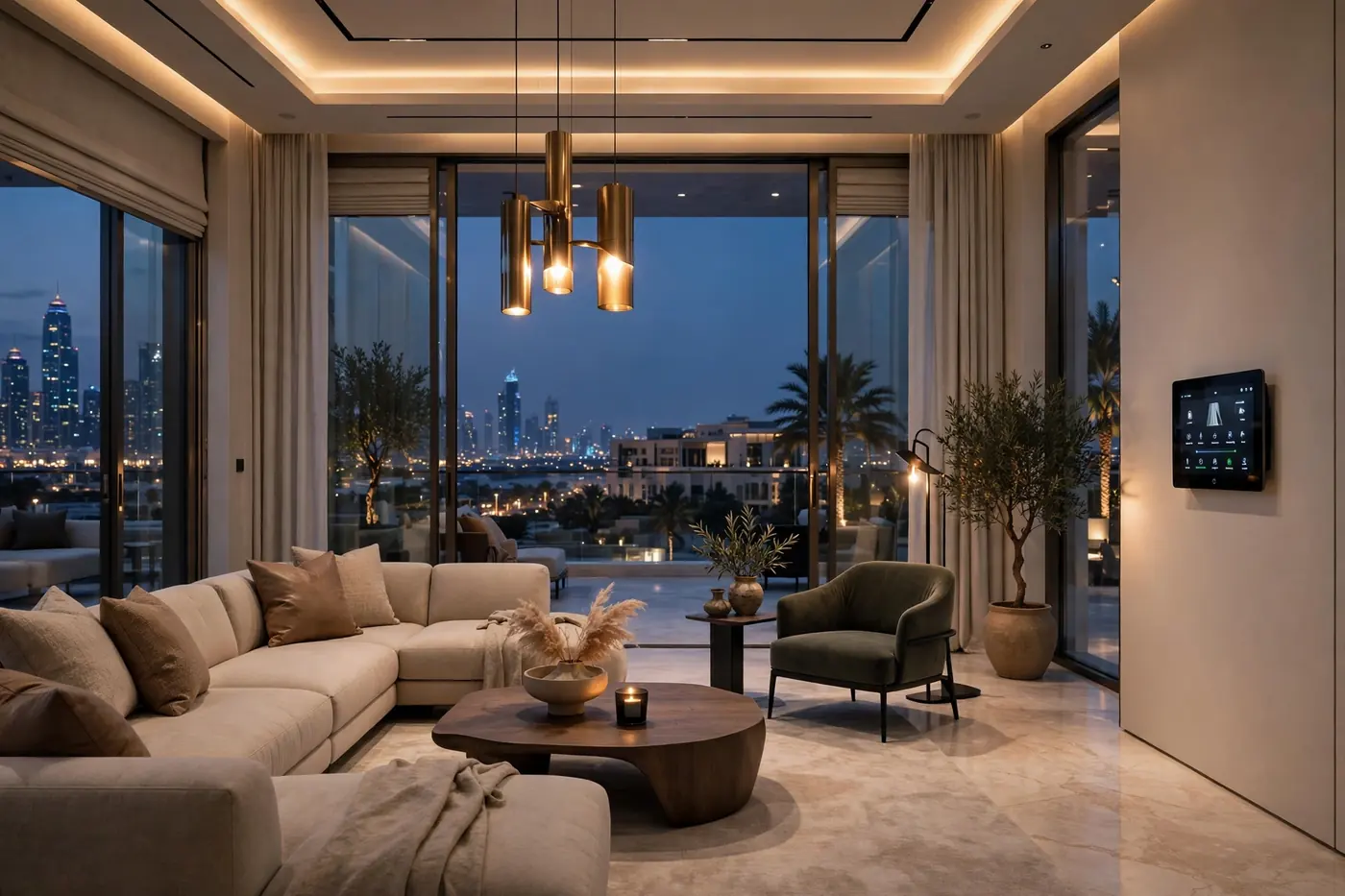
Smart homes have moved from novelty to normal in the Emirates: villas that cool themselves before you arrive, curtains that close against the afternoon sun, and a single app for lights, locks and cameras. Home automation in UAE ranges from a few smart bulbs and a voice assistant to fully wired systems designed into new villas. This guide explains what can be automated, how the main system types differ, what new-build and retrofit projects involve, how costs build up, and how to choose an integrator whose system your family will actually enjoy using.
What Can Be Automated
Lighting is usually the starting point: scenes for evenings and entertaining, dimming, and lights that respond to arrival, time or motion. Climate control follows — smart thermostats and AC control that learn schedules and cut waste in a country where cooling runs most of the year. Motorised curtains and blinds manage glare and heat, and the options in our guide to blinds in UAE show how often the two are specified together.
Security and access form the second layer: video doorbells, smart locks, intercoms and cameras, planned alongside the dedicated systems in our guide to CCTV cameras in UAE. Add audio and TV control, garden irrigation, pool equipment and leak and smoke alerts, and the pattern is clear — automation is less about gadgets than about the house quietly managing routine jobs in the background.
System Types: Wireless, Wired and Platforms
Wireless systems built on standards such as Zigbee, Z-Wave and Wi-Fi suit apartments and retrofits: devices are added room by room, controlled through apps and voice assistants, and moved or expanded easily. The trade-offs are dependence on your home network and a patchwork of apps if you mix brands carelessly, which is why a single platform — chosen early — matters more than individual device features.
Fully wired systems, often built on KNX, are designed into new villas and major renovations: keypads and sensors on a dedicated bus, centralised control, and the reliability commercial buildings expect. They cost more and need professional design, but they disappear into the house. Many homes end up hybrid — wired backbone for lighting and climate, wireless for the rest — installed with the help of the professionals in our guide to electricians in UAE where mains work is involved.
New Build vs Retrofit Projects
In a new build, automation is cheapest and cleanest at design stage: cabling, control panels and rack space are planned with the electrical drawings, and neutral wires and deep back-boxes are specified before walls close. If you are building or renovating, raise automation with your contractor at the same time as lighting design — retrofitting wired systems after handover multiplies cost and disruption.
Retrofits in finished homes lean on wireless devices and smart switches that fit existing wiring, plus battery sensors where cables cannot run. A good integrator surveys first: router placement and Wi-Fi coverage, the state of the distribution board, and which existing systems — AC units, curtains, alarm — can be integrated rather than replaced. Landlords and tenants should note that most wireless setups are removable, which makes them rental-friendly in a way wired systems are not.
Voice control deserves a word of its own, because it is how many households first meet automation. Assistants from the major platforms can drive lights, scenes and climate once devices are grouped sensibly, and children and guests take to them instantly. Plan names carefully — rooms and scenes labelled the way your family actually speaks — because a system that misunderstands a simple request twice gets abandoned for the wall switch. Voice works best as one layer over well-designed keypads and apps, not as the only interface.
How Automation Costs Build Up
Costs stack in layers: devices and keypads, the central processor or hub, cabling and installation labour, programming and scene design, and the control interfaces — touch panels, apps and voice. A single-room wireless setup starts modestly; a whole-villa wired system is a construction line item. Programming is the cost people underestimate and the one that decides whether the system feels magical or maddening.
Ask for itemised quotes that separate hardware from labour and programming, and ask what expansion costs later — adding a room should not require replacing the core. Energy features can offset part of the spend over time, especially paired with generation: our guide to solar panels in UAE explains how rooftop systems feed the same household energy picture that automation then manages intelligently.
Comfort and Energy in Gulf Conditions
The Emirates’ climate is where automation earns its keep. Cooling is the largest household energy cost, and scheduling, zoning and setback temperatures when the house is empty deliver real savings — our guide to air conditioning in UAE covers the systems being controlled. Automated blinds closing ahead of the afternoon sun reduce heat gain before the AC ever feels it, and leak sensors catch the pipe failures that quietly damage villas.
Reliability planning matters as much: systems should fail gracefully, with manual switches that still work when the network is down, and surge protection for sensitive electronics. For homes that double as offices, the network and security thinking in our guide to computer security systems in UAE applies to the automation network too — a smart home is a small IT system and deserves the same basic hygiene.
Think about the household’s edge cases before sign-off. What happens when internet service drops, when a phone is lost, when domestic staff need access without full control, or when you sell or rent the property? Good designs answer all four: local control that works offline, user levels for staff and children, and a documented handover that lets a future owner or tenant inherit a working system rather than a mystery. These questions sound dull beside a lighting demo; they decide whether the system is still loved in year three.
Choosing an Integrator
Automation is a service relationship, not a one-off purchase, so choose the integrator before the gadgets. Look for a licensed company with a showroom or reference homes, designs drawn before products are pushed, and documentation handed over at completion: network details, programming files, passwords and warranties. Ask who supports the system in two years and what a service visit costs.
Insist on a demonstration using your own daily routines — arriving home, movie night, guests, travel mode — and on training for the whole household before sign-off. Start with the rooms you live in most, prove the system, then expand. The best smart homes in the Emirates share a trait: guests never notice the technology, only that the house always seems to be at the right temperature, light and mood.