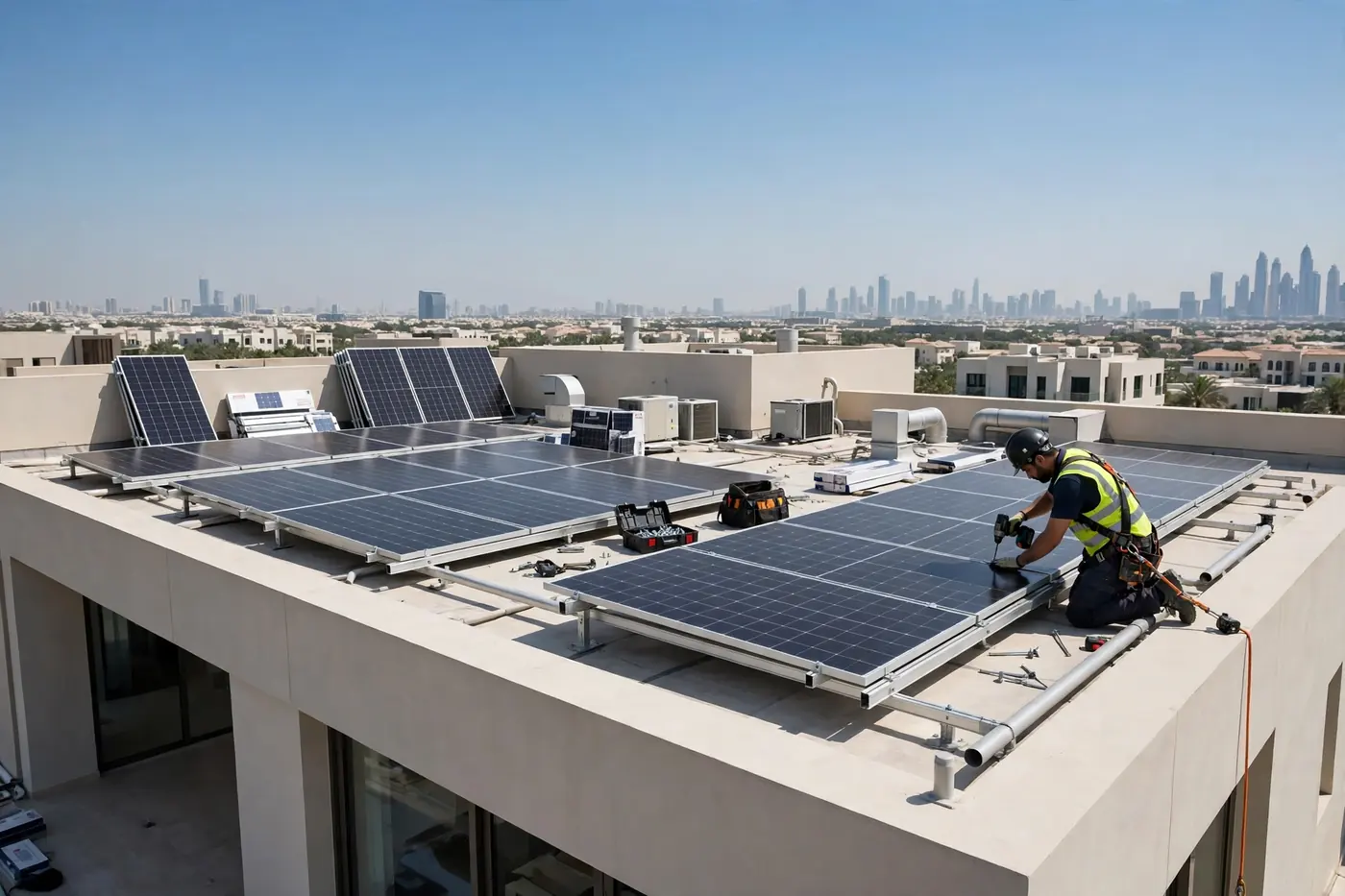
Few countries suit rooftop solar like the Emirates: sunshine is abundant, air conditioning drives large electricity bills, and villas across Dubai and Abu Dhabi have the roof space to make generation worthwhile. Solar panels in UAE are moving from a niche upgrade to a standard consideration for villa owners, warehouses and businesses watching their DEWA or ADDC bills climb every summer. This guide explains how home solar works here, the approval process, costs and savings, and how to choose an installer.
How Rooftop Solar Works in the UAE
Panels convert sunlight into direct current electricity, which an inverter turns into the alternating current your home uses. During the day your appliances run on solar power first; any surplus flows back to the grid under the local net-metering arrangements, Shams Dubai in Dubai and the equivalent scheme in Abu Dhabi, and is credited against what you draw at night. Most residential systems have no batteries: the grid effectively acts as the storage.
System size is measured in kilowatts peak. Sizing starts from your consumption, especially the summer air-conditioning load, and from usable roof area after allowing for water tanks, AC units and access paths. A competent installer models your bills month by month rather than quoting from annual averages, because generation and consumption both peak in summer here, which is actually a good match. The electrical work must integrate safely with your distribution board, which is why solar projects often involve licensed electricians in UAE alongside the solar crew.
Approvals: Shams Dubai and Beyond
Grid-connected systems need approval from the utility before installation. In Dubai, the Shams Dubai programme sets the process: a DEWA-approved consultant or contractor submits the design, the installation is inspected, and a special meter records both consumption and export. Other emirates run similar schemes through their own utilities and municipalities.
Community rules also apply. Many villa communities require management approval for visible rooftop changes, and tenanted properties need the landlord’s consent. A legitimate installer handles the paperwork as part of the job and will not suggest connecting anything without approval; unapproved connections risk fines and disconnection.
Costs, Savings and Payback
Costs are usually quoted per kilowatt installed or as a full turnkey price including panels, inverter, mounting, cabling, approvals and connection. Savings depend on how much of your consumption happens in daylight and on your tariff slab: households whose bills are driven by daytime cooling see the fastest returns, while homes empty all day export more at lower value.
Installers should give you a written estimate of annual generation and savings with their assumptions visible, and payback periods are typically discussed in years rather than months. Treat any promise of zero bills with suspicion. Solar also pairs naturally with reducing the load itself: efficient air conditioning in UAE and sound water tank cleaning in UAE schedules are part of the wider picture of running an efficient villa, alongside pool equipment choices covered in our swimming pool cleaning in UAE guide.
Panels, Inverters and Gulf-Proofing
Heat is the design constraint here. Panel output falls as cell temperature rises, so quality panels with good temperature coefficients, mounted with airflow beneath them, perform noticeably better over a Dubai summer. Dust is the second enemy: unshaded roofs in sandy districts can lose meaningful output between cleans, so ask about cleaning access and frequency before the system goes up.
Mounting hardware must resist corrosion, fixings must respect the roof’s waterproofing, and inverters belong in shaded, ventilated spots rather than baking on a sunlit wall. If your project is part of a larger property upgrade, coordinate roof work with renovation services in UAE so scaffolding, waterproofing and solar installation happen in the right order and warranties do not conflict.
Maintenance and Monitoring
Solar systems are low-maintenance but not no-maintenance. Panels need periodic cleaning, more often after sandstorms, and most modern inverters report generation to an app so underperformance is spotted quickly. An annual check of connections, mounting and inverter health is cheap insurance. Warranties come in layers: product warranties on panels and inverters, and a performance warranty on panel output over time. Keep all three documented, with the installer’s details, in case ownership of the home changes.
Solar for Warehouses and Businesses
Commercial roofs change the economics. Warehouses and factories around Jebel Ali, Sharjah Industrial and Mussafah have vast flat roofs and heavy daytime loads from cooling, lighting and machinery, which is close to the ideal profile for solar: generation and consumption rise and fall together. Larger systems are designed with structural checks, utility submissions at greater scale and sometimes power-purchase arrangements where a developer funds the installation and sells the electricity to the occupant.
For businesses, the decision usually runs through facilities and finance together: roof condition and remaining lease term, the tariff structure, and how the savings present in operating costs. If your premises are leased, start the landlord conversation early, because consents and roof warranties decide timelines more often than panel supply does.
Choosing a Solar Installer
Use only utility-approved contractors, and compare at least two designs for your roof rather than two prices for the same guess. Ask for local installations you can reference, their assumptions for generation and savings in writing, and who handles approvals and the inspection. The right installer will talk as much about your consumption patterns as about their panels. In a country built on sunshine, that honesty is what turns a bright idea into a sound investment.