Behind almost every product launch, property handover and trade exhibition in the Emirates sits a printing press. The UAE’s print industry — concentrated in Dubai and Sharjah’s industrial zones — produces everything from business cards and restaurant menus to packaging, vehicle wraps and exhibition stands. Whether you need five hundred flyers or fifty thousand boxes, this guide explains how printing presses in the UAE work, the main methods they use, and how to choose a printer who delivers on time and on colour.
The UAE Print Industry at a Glance
Sharjah has long been a centre for print and publishing, while Dubai’s industrial areas host large commercial presses serving the whole country and re-export markets. That depth means buyers can find everything in one market: prepress studios, offset houses, digital print shops for short runs, packaging specialists and large-format printers for signage. Many firms also handle finishing in-house — lamination, foiling, die-cutting and binding — so a single order can go from artwork file to finished, boxed product without leaving the building.
New businesses usually meet the industry early, ordering signage, stationery and marketing material right after completing the steps in our business verification checklist. Print is also one of the services new companies arrange alongside the paperwork support described in our guide to PRO services in the UAE.
Printing Methods Explained
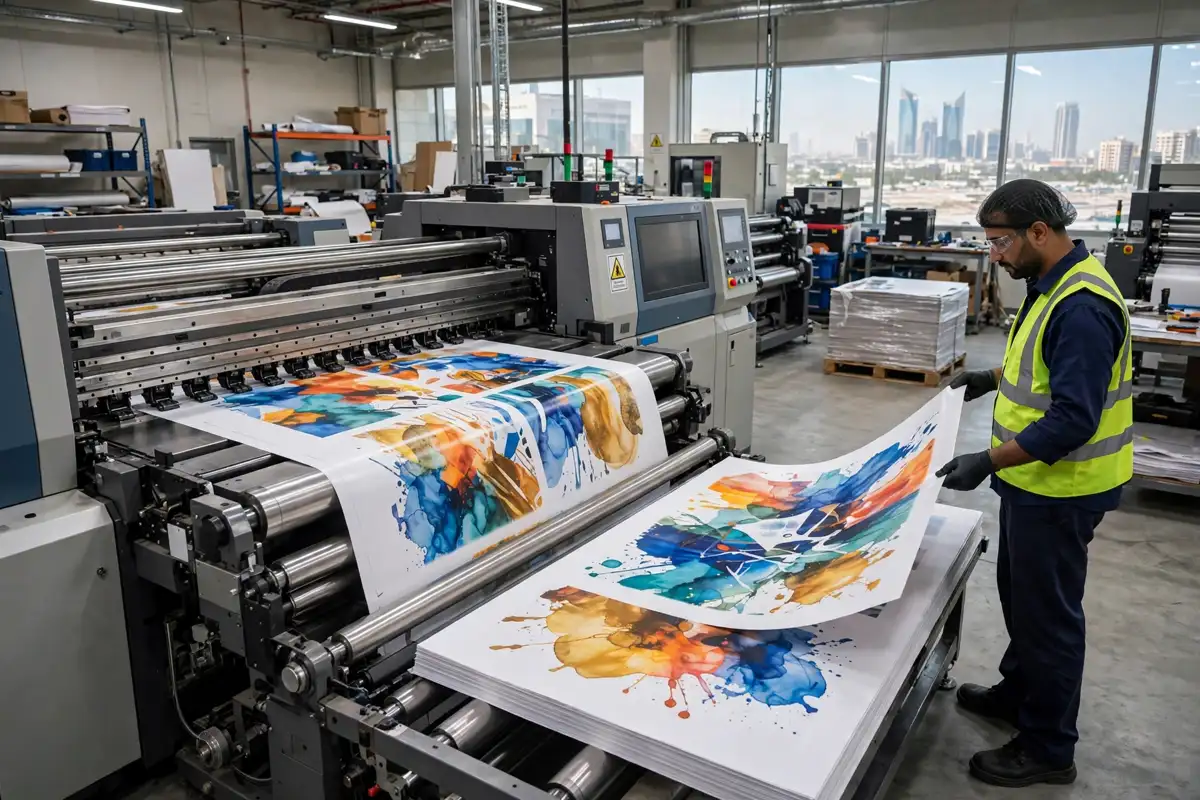
Offset printing remains the workhorse for volume. Plates are made for each colour, so setup costs more, but the per-copy price drops sharply on long runs and colour consistency is excellent. Choose offset for magazines, catalogues, packaging and any job running into the thousands.
Digital printing prints directly from file with no plates. It is faster to start, ideal for short runs, personalised pieces and anything needed within a day or two, and quality now rivals offset on most stocks. Screen printing pushes ink through a mesh and is the standard for apparel, tote bags and promotional items. Large-format printing covers banners, hoardings, vehicle graphics, window films and exhibition backdrops — the printers exhibiting companies rely on, as our guide to event management in the UAE explains when it covers stand build-outs.
What Businesses Commonly Print
Everyday orders include business cards, letterheads, invoices and folders. Restaurants print menus and table cards; retailers print bags, tags, shelf talkers and seasonal sale graphics. Packaging is a major category of its own — rigid boxes, sleeves and labels for the food, cosmetics and perfume brands that manufacture or assemble in the UAE. Offices relocating or expanding often bundle print orders with the move itself, a detail covered in our guide to relocation services in the UAE.
Government-facing paperwork is usually typed and processed rather than printed commercially, but the same industrial areas host the typing centres in the UAE that handle forms and applications, so business errands can often be combined into one trip.
How to Choose a Printing Press
Ask to see samples of work similar to yours, printed on the same stock you plan to use — a glossy brochure proves nothing about an uncoated recycled paper. Confirm whether prepress is in-house, because a good prepress operator will catch low-resolution images and missing bleed before they become your problem. Get the schedule in writing: file approval, proof, print, finishing and delivery are separate steps, and most delays happen at proof stage because the client’s artwork needed fixes.
For colour-critical work such as brand packaging, request a physical proof. Screens lie; paper does not. Finally, check delivery capability — established presses run their own vans across the Emirates, while smaller shops rely on couriers, which matters for fragile or bulky items. Larger facilities print their own wayfinding and safety signage too, often as part of contracts run by facility management companies in the UAE.
Sustainable Printing and Turnaround Planning
Print buyers increasingly ask about environmental impact, and UAE presses have responded with recycled and FSC-certified paper ranges, soy-based inks and plate processes that use less chemistry. Digital printing helps in a different way — printing only the quantity needed, when it is needed, instead of warehousing thousands of copies that quietly go out of date. If sustainability features in your company’s reporting, ask the printer what certifications their papers carry and whether offcuts and waste are recycled; the answers are usually better than buyers expect.
Turnaround deserves the same honesty. A straightforward digital job can be ready the same or next day; an offset job with special finishing needs days, not hours, because plates, drying time and binding cannot be compressed. Build the printer’s schedule into your own launch plan, approve proofs quickly, and keep a small buffer stock of anything you hand out daily. Most print emergencies are planning emergencies wearing a disguise.
Preparing Your Files and Controlling Cost
Most print problems are file problems. Supply print-ready PDFs with fonts embedded, images at 300 dpi, colours in CMYK and 3 mm bleed on every trimmed edge. Name one person on your side to approve the proof — committees approving by group chat are how wrong phone numbers end up on ten thousand flyers.
Cost is driven by quantity, paper, colours, finishing and turnaround. Standard sizes on house papers are always cheaper than custom sizes on imported stocks, and a two-day rush can cost more than the paper itself. If you print regularly, consolidate orders into fewer, larger runs and keep a stock of generic items — unbranded boxes, plain bags — that never change. Choose the method honestly, prepare files properly, and a printing press in the UAE will feel less like a supplier and more like part of your own operations team.