Choosing CNC milling machines in UAE workshops is a decision that shapes accuracy, output and operating costs for years, so it pays to understand the options before you buy. Computer numerical control milling uses rotating cutting tools, guided by a programmed toolpath, to remove material from metal, plastic and other workpieces with a level of repeatability that manual machining cannot match. This guide covers the main machine types, where they are used across the Emirates, and the practical questions to ask when selecting, installing and running one.
How CNC Milling Works
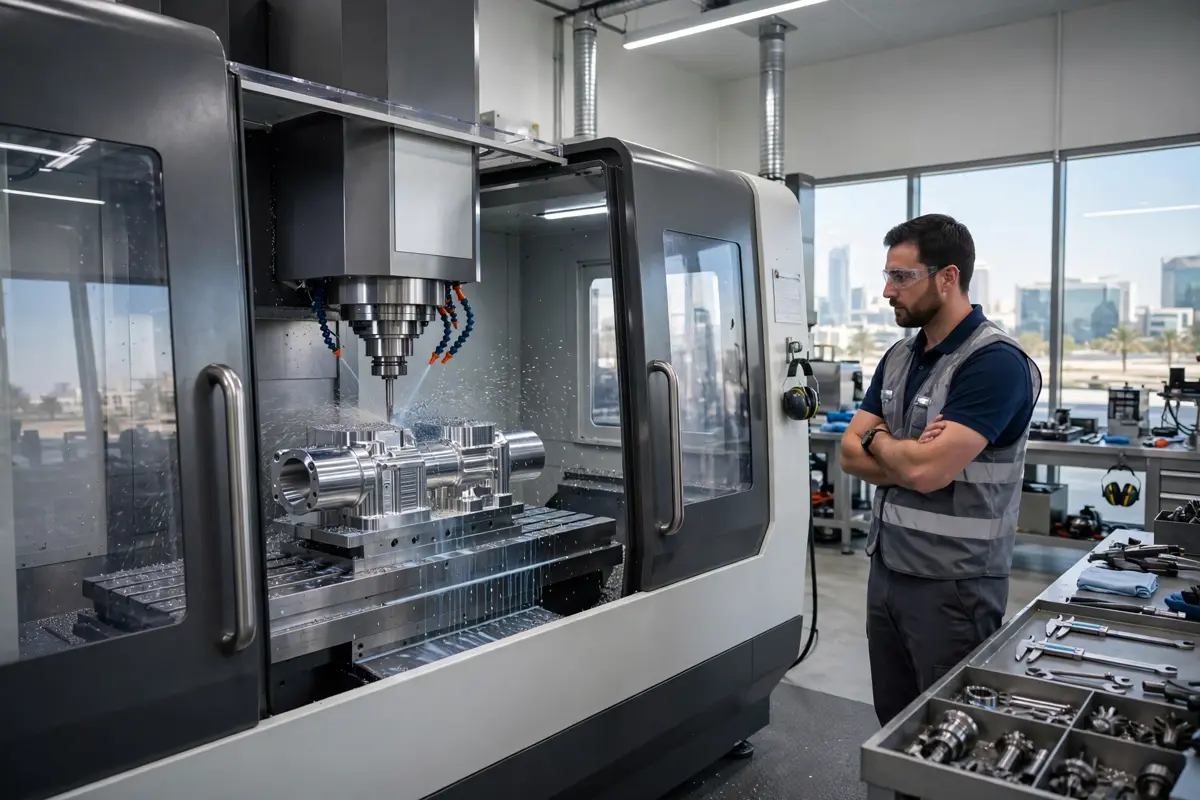
In CNC milling, a designer or programmer creates a digital model of the part and converts it into instructions the machine can follow. The machine then moves the workpiece, the cutting tool, or both, along several axes while the spindle rotates the tool at controlled speeds. Coolant, tool changes and feed rates are managed as part of the programme, which means the same part can be produced again and again with consistent dimensions.
The appeal for UAE manufacturers is straightforward: complex shapes, tight tolerances and repeatable quality, with less dependence on scarce manual machining time for routine work. Milling sits alongside turning, grinding and cutting processes in a modern machine shop. If you are new to the field, our introduction to CNC machining in the UAE explains how these processes fit together in practice.
Main Types of CNC Milling Machines
The most common distinction is between vertical and horizontal machining centres. In a vertical machine, the spindle points downwards towards the table, which makes setup visible and convenient for many general jobs, training and prototype work. Horizontal machines, where the spindle is oriented sideways, are often favoured for heavier production work, better chip evacuation and machining several faces of a part with suitable fixtures.
Axis count is the other key choice. A three-axis machine handles a wide range of flat and moderately contoured parts. Adding a fourth axis allows rotation of the workpiece, and five-axis machines can approach the part from many angles in a single setup, which suits complex aerospace, medical and mould components. More axes bring more capability, but also more cost, programming complexity and maintenance, so the right choice depends on the work you actually expect to do.
Size and construction matter too. Bed mills, gantry machines and compact desktop units all exist for different scales of work, while travelling-column designs serve very large components. Whatever the format, rigidity is fundamental: a stiff, well-built machine holds accuracy better and handles cutting forces without vibration. Buyers comparing the wider market should also look at our overview of machine tools in the UAE and the related guide to metalworking machine tools for context on neighbouring equipment.
Where CNC Milling Is Used in the UAE
CNC milling supports many of the Emirates’ established industries. Oil and gas suppliers machine flanges, valve components and custom fittings. Construction and architectural metalwork businesses produce brackets, plates and bespoke features. Marine, automotive and general engineering workshops rely on milling for repair parts and short production runs, while signage, interiors and product manufacturers use smaller machines for plastics, composites and aluminium.
Milling rarely works in isolation. A part may be milled, then cut, drilled, finished or assembled with components made by other processes. Workshops commonly combine milling with laser cutting in the UAE for sheet profiles, and they depend on quality tooling such as the cutters covered in our guide to diamond cutting tools for specialist work. Understanding the full workflow helps you judge whether a particular machine will fit your existing operation or leave a bottleneck elsewhere.
What to Check Before You Buy
Start with your parts, not with a catalogue. List the materials you will cut, the largest workpiece dimensions, the tolerances you must hold and the volumes you expect. Those answers point you towards the working envelope, spindle power and speed range, tool magazine capacity and control system you need. Buying far beyond your real requirements ties up capital and floor space, while buying too small leaves you unable to accept profitable work.
Ask about the control system and whether your team, or the operators you can realistically hire, can work with it. Check compatibility with your design and programming software, and clarify what training the supplier provides. Then look carefully at service and support: who maintains the machine locally, how quickly can an engineer attend, and are spare parts and common tooling readily available in the UAE? A machine that waits weeks for a part is expensive however good its specification looks.
Consider total cost of ownership rather than purchase price alone. Tooling, workholding, coolant, power, servicing, software and training all add up, as does installation. Used machines can be good value, but they need thorough inspection of accuracy, spindle condition, backlash and service history. For a broader view of how milling fits into capital planning, see our guide to industrial machinery in the UAE.
Installation, Power and Workshop Setup
A CNC mill needs a suitable foundation, stable power supply and enough clear space for loading material, removing finished parts and maintaining the machine safely. Plan material flow before the machine arrives: where raw stock is stored, how heavy workpieces will be lifted, and where finished components and metal chips will go. In the UAE climate, workshop temperature and dust control also deserve attention, since heat and airborne dust affect both electronics and accuracy over time.
Compressed air, coolant management and chip disposal should be arranged in advance. So should safety systems, including guarding, emergency stops and clear operating procedures. If your facility also runs equipment such as that described in our guide to woodworking machinery in the UAE, keep dust-generating processes sensibly separated from precision machining areas.
Getting the Best From Your Machine
Once installed, performance depends on people and habits as much as hardware. Invest in operator and programmer training, keep a proper maintenance schedule, and calibrate and check the machine on a routine basis rather than waiting for quality problems. Good workholding, sensible tool selection and well-planned toolpaths reduce cycle times, tool wear and scrap.
Keep records of jobs, setups and recurring issues. That information makes quoting more accurate, helps new staff learn faster and reveals which work is genuinely profitable. Many successful UAE workshops grow gradually: they master one machine and a clear niche, build reliable turnaround, and only then expand capacity.
The right CNC milling machines in UAE settings are not necessarily the biggest or the most complex — they are the machines matched to your parts, your team and your support network, installed properly and run with discipline. Take time over that match, and a milling machine becomes one of the most productive and dependable assets in your workshop.