
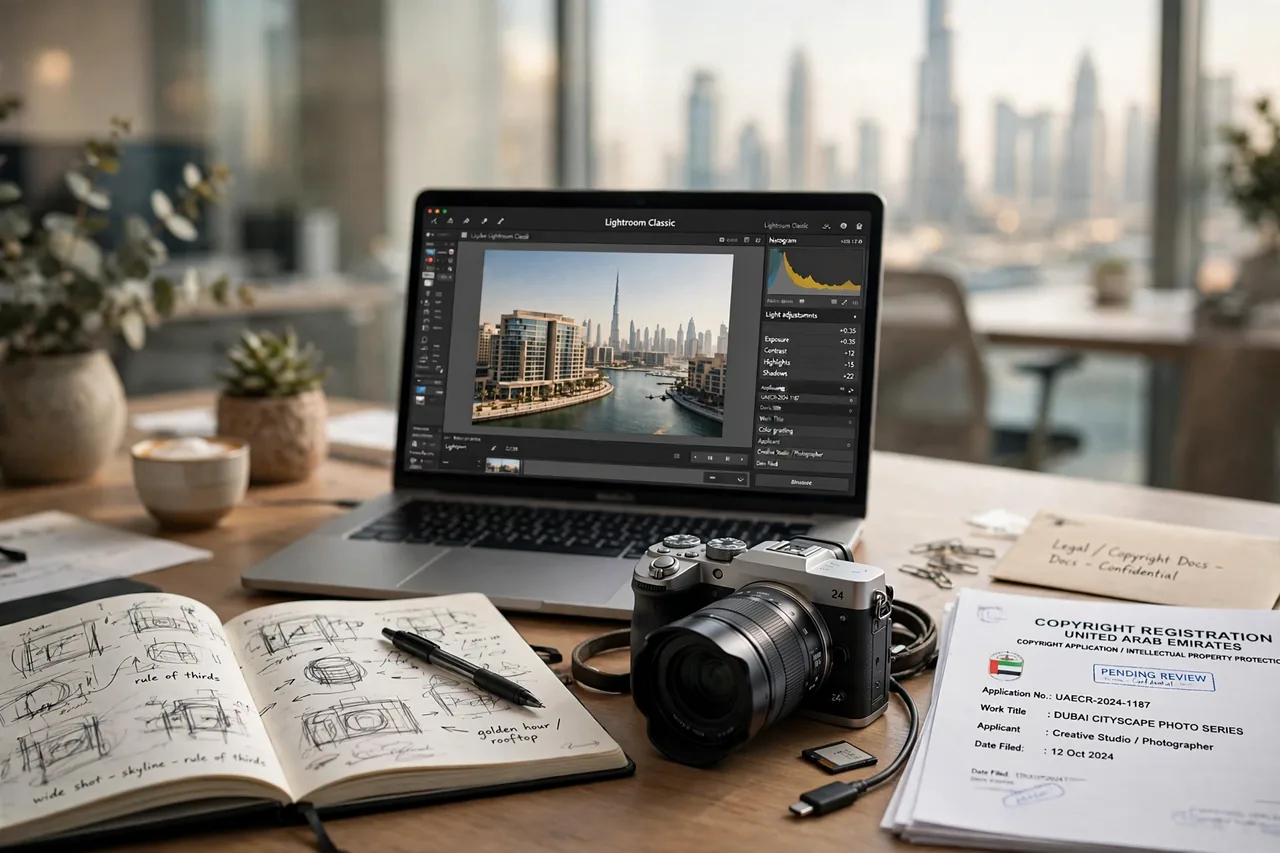
Copyright registration in the UAE is a topic that confuses many creators and businesses, because two things are true at once: your work is protected by copyright automatically the moment you create it, and registering it with the authorities is still worthwhile. Photographers, writers, designers, musicians, software developers and businesses across the Emirates all hold copyright in their work, and a registration certificate from the UAE Ministry of Economy is the cleanest proof that the work is yours and when you made it. This guide explains what copyright covers, how registration works, and when it matters most.
What Copyright Protects
UAE copyright law — the Federal Decree-Law on Copyrights and Related Rights — protects original creative works in many forms: books, articles and other writing; photographs and artworks; music and audio recordings; films and videos; software and databases; architectural and technical drawings; and designs and creative content published online. Protection covers the expression of an idea, not the idea itself: your written guide is protected, while the general topic remains free for anyone to write about. Copyright also gives the owner economic rights (to copy, publish, license and sell the work) and moral rights (to be credited and to object to distortion of the work), which under UAE law stay with the creator even when economic rights are transferred.
Copyright, Trademark or Patent: Which Do You Need?
These three rights are often mixed up. Copyright protects creative works — content, images, code, music. A trademark protects brand identity — your business name, logo and slogan — and is the right most companies need first when they launch. Patents protect inventions and technical solutions, while industrial designs protect the look of a product. A single business may need all three: a software company holds copyright in its code, a trademark in its brand, and possibly a patent in a technical process. Founders already working through licensing steps with business setup consultants in Abu Dhabi or Dubai should raise intellectual property in the same conversation, because the best time to secure rights is at the start.
Why Register if Protection Is Automatic?
Automatic protection means the right exists; registration is about proving it. A Ministry of Economy registration certificate records the work, the author and the date in an official register, which becomes powerful evidence if a dispute reaches a platform, a client or a court. Registration also smooths practical transactions: buyers, publishers and licensees often ask for proof of ownership before paying for work, and a certificate answers them in one document. For freelancers and agencies, it settles the common argument about who created something first. Think of registration as the difference between owning a car and holding its registration papers — the second is what you reach for when ownership is questioned.
How to Register Copyright in the UAE: Step by Step
Applications are filed with the UAE Ministry of Economy, which handles copyright through its smart services channels. In outline, the process is:
1. Prepare the work in its final form — the manuscript, image files, recordings or code you want recorded.
2. Gather identification and, for companies, trade licence details; agents and consultants can file on your behalf with proper authorisation.
3. Submit the application with details of the work, its category and its authors through the Ministry’s service channel, and pay the applicable government fee (fees depend on the category of work and applicant type, so check the current schedule on the Ministry’s website before filing).
4. The application is examined, and once approved the registration certificate is issued, recording your ownership from the filing details.
The paperwork side is where many applicants use support services: typing centres in the UAE and PRO services in the UAE routinely prepare and submit government applications of exactly this kind, and established firms from the list of business setup companies in Dubai handle IP filings alongside licensing.
How Long Does Copyright Last?
Under UAE law, economic rights in most works last for the life of the author plus fifty years after their death, after which the work enters the public domain. Some categories — such as works owned by companies, applied art, and broadcasts — have their own fixed terms counted from publication or creation. Moral rights, by contrast, do not expire. The practical point for businesses: content you commission today remains an asset for decades, which is why contracts with freelancers should state clearly who owns the copyright in the delivered work. Businesses that track such assets alongside their finances can keep licences and renewals in order with the tools covered in our guide to accounting software in the UAE.
Copyright When You Commission Work from Others
Businesses often assume that paying for content settles ownership. It does not — not automatically. Under UAE law, the creator of a work is its first owner, and while contracts can transfer the economic rights to the commissioning business, that transfer should be written down: what rights pass, for what uses, and whether the creator keeps portfolio rights. Agencies and freelancers across the Emirates work under such agreements every day, covering website copy, photography, branding artwork, video and software. If your company commissions creative work regularly, a standard IP clause in your contracts — reviewed once by a legal professional and then reused — prevents nearly all ownership disputes before they start, and pairs naturally with registering your most valuable finished works.
What to Do if Your Work Is Copied
Start with evidence: keep dated source files, drafts and your registration certificate if you have one. For online copying, most platforms run notice-and-takedown processes that respond well to a registration certificate or dated proof of authorship. For commercial misuse — a competitor reusing your catalogue, photos or software — a lawyer’s notice is usually the next step, and UAE courts can award compensation and order infringing copies destroyed. Prevention helps too: publish with clear copyright notices, watermark preview images, license your work in writing, and register the pieces that carry real commercial value — your catalogue, brand content, course material and software — rather than trying to register everything you produce.