
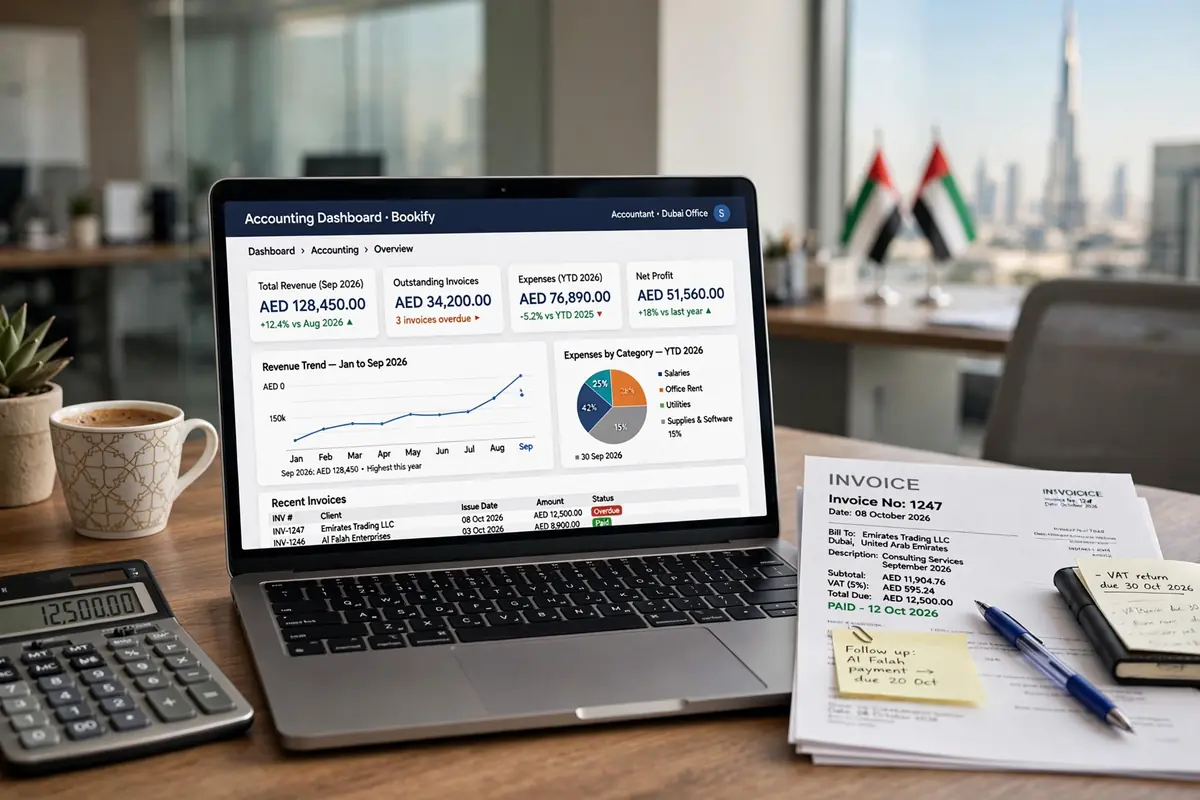
Choosing the right accounting software in UAE can save a small business hours of admin every month — and keep it compliant with VAT and corporate tax rules. Whether you run a mainland company, a free zone entity, or a growing e-commerce brand, your books must be accurate, audit-ready, and filed on time. Modern cloud tools generate VAT-compliant invoices, reconcile bank transactions, and produce the reports your accountant needs. This guide compares the best accounting software in UAE, explains the features that matter locally, and gives realistic price ranges so you can choose with confidence.
Why Accounting Software Matters in UAE
Accounting in the UAE is not just about recording sales. Since VAT was introduced, every registered business must charge the correct VAT, keep proper records, and file returns on time — mistakes can mean penalties from the Federal Tax Authority. Corporate tax has added another layer: companies must track taxable income, keep supporting documents, and prepare for filing. Good software reduces both risks. It applies the right VAT treatment to invoices, flags missing data before a return is due, and keeps a clear audit trail. Beyond compliance, it gives owners a live picture of cash flow. Professional invoicing also helps you get paid faster: clear, branded invoices with payment links and automatic reminders reduce delays. Clean records also make recovery of unpaid invoices easier.
Key Features to Look For
Not every accounting tool is built for UAE requirements. Before you compare brands, check that the software covers these essentials:
- VAT and FTA compliance: UAE VAT rates, tax invoices, credit notes, and VAT return reports that match Federal Tax Authority formats.
- Professional invoicing: branded, VAT-compliant invoices, quotes, recurring billing, and automatic payment reminders.
- Bank reconciliation: automatic bank feeds from UAE banks and matching of receipts.
- Multi-currency support: AED as the base currency, plus USD, EUR, GBP, and INR invoicing with automatic exchange-rate updates.
- Arabic and English: bilingual invoices and reports for clients and government portals.
- Reports and dashboards: profit and loss, balance sheet, cash flow, VAT summaries, and ageing reports for receivables and payables.
- Cloud and mobile access: secure cloud storage, accountant access, role-based permissions, and mobile access.
Best Accounting Software in UAE
These six options cover most UAE businesses, from freelancers to mid-sized companies.
- QuickBooks Online: the most widely used choice among UAE SMEs. It offers strong invoicing, bank feeds, VAT reports, and payroll add-ons. Best for: small and growing businesses that want broad support.
- Xero: popular with accountants and tech-savvy owners. Its clean interface and strong bank reconciliation connect payments, inventory, and reporting easily. Best for: businesses that work closely with an external accountant.
- Zoho Books: a strong value option, especially for Zoho users. It covers VAT invoicing, multi-currency, and client portals at a lower price. Best for: budget-conscious SMEs and Zoho users.
- Tally Prime: popular in trading and manufacturing businesses. It handles inventory, GST-style tax logic, and detailed ledgers well. Best for: established trading firms and accountants trained on Tally.
- Sage Accounting: suits mid-sized companies that need stronger controls, multi-entity reporting, and audit trails. Best for: mid-sized firms with in-house finance staff.
- UAE-local options: several UAE-based providers and localised versions of global tools add Arabic-language support, FTA-aligned VAT reports, and local payroll features such as WPS and gratuity calculations.
Accounting Software for Small Business in UAE
For a small business in UAE, simplicity beats complexity. Start with invoicing, expenses, bank reconciliation, and VAT returns — you can add inventory, payroll, and project tracking later. A separate business bank account makes reconciliation far easier, because personal and business spending stay apart. Free plans can suit a freelancer with a handful of invoices a month, but check the limits: many free tiers cap invoices, users, or reports, and lack VAT filing support. Paid SME plans usually pay for themselves in saved accountant time alone. Run a one-month trial on real data and test the full cycle: quote, invoice, payment, VAT return, and month-end report.
Prices in UAE
Accounting software price in Dubai and across the UAE depends on users, features, and whether you pay monthly or annually. Roughly: free plans cost AED 0 but are limited; entry-level SME plans run about AED 50–150 per month; mid-range plans with multi-user access, inventory, and payroll cost roughly AED 150–450 per month; and enterprise or multi-entity systems can exceed AED 1,000 per month. Some tools charge per user, while others offer flat pricing for a set number of users — flat plans suit teams, per-user plans suit solo owners. Watch for extras — implementation, migration, training, payroll add-ons, and card fees — beyond the headline price. Check it reconciles business credit card transactions automatically.
How to Choose & Switch
Start with your needs, not the brand. List your must-haves: VAT filing, payroll, inventory, multi-currency, or multi-branch reporting. Shortlist two or three tools, take free trials, and score each on ease of use, local support, and accountant familiarity. Before switching, back up your old data, agree a cut-off date with your accountant, and migrate opening balances, customer lists, and unpaid invoices. Check that the system fits your structure — mainland or Ras Al Khaimah — and that support covers your working hours. If you are still setting up, see our guide to business setup companies in Dubai.
FAQs
What is the best accounting software in UAE for VAT?
QuickBooks, Xero, and Zoho Books all handle UAE VAT well, with tax invoices, credit notes, and VAT return reports. The best choice depends on your size, budget, and accountant’s preference.
Should I choose cloud or desktop accounting software?
Cloud software suits most UAE businesses because it updates automatically, allows accountant access, and works from any device.
Do I still need an accountant if I use accounting software?
Yes. Software records and organises your figures, but an accountant checks VAT treatment, prepares corporate tax filings, and advises on deductions and structure. Think of software as a tool, not a replacement.
How long does it take to set up accounting software?
A freelancer can be up and running in a day. An SME with bank feeds, opening balances, and VAT settings usually needs one to two weeks, including a trial run and a review by the accountant.
Accounting software in UAE is no longer a luxury — it is the backbone of compliant, well-run finances. Pick a tool that fits your size, your VAT obligations, and your growth plans, and keep your books clean so every decision rests on reliable numbers. Whether you grow, face an audit, or eventually close the company, good records make every step simpler.