The United Arab Emirates runs one of the most modern and connected transport networks in the world. From the driverless Dubai Metro to intercity buses that link all seven emirates, transportation systems in UAE make it easy for residents and visitors to travel without a car. Whether you commute in Dubai or visit Sharjah, knowing the options saves time and money.
Public transport in the UAE is run by emirate-level authorities, led by Dubai’s Roads and Transport Authority (RTA) and Abu Dhabi Mobility. Together they operate metro lines, trams, buses, ferries, taxis, and ride-hailing services, all connected by smart cards and mobile apps. This guide explains each option and what it costs.
Public Transportation in UAE — Metro, Tram, Buses, Ferries, Taxis
Dubai has the largest public transport UAE network in the country. The Dubai Metro and Dubai Tram cover the city’s main corridors, while hundreds of RTA bus routes serve neighbourhoods, business districts, and suburbs. Water buses and ferries connect Dubai Marina and Dubai Creek.
Abu Dhabi relies on a comprehensive bus network run by Abu Dhabi Mobility, with city, suburban, and regional services across the capital and Al Ain. Sharjah runs its own bus services and shares intercity routes with Dubai and Abu Dhabi, so daily travel between emirates is straightforward.
One Nol card works across Dubai’s metro, tram, buses, and water transport, while Abu Dhabi uses the Hafilat card.
Dubai Metro & Tram — Lines, Stations, Nol card, Timings
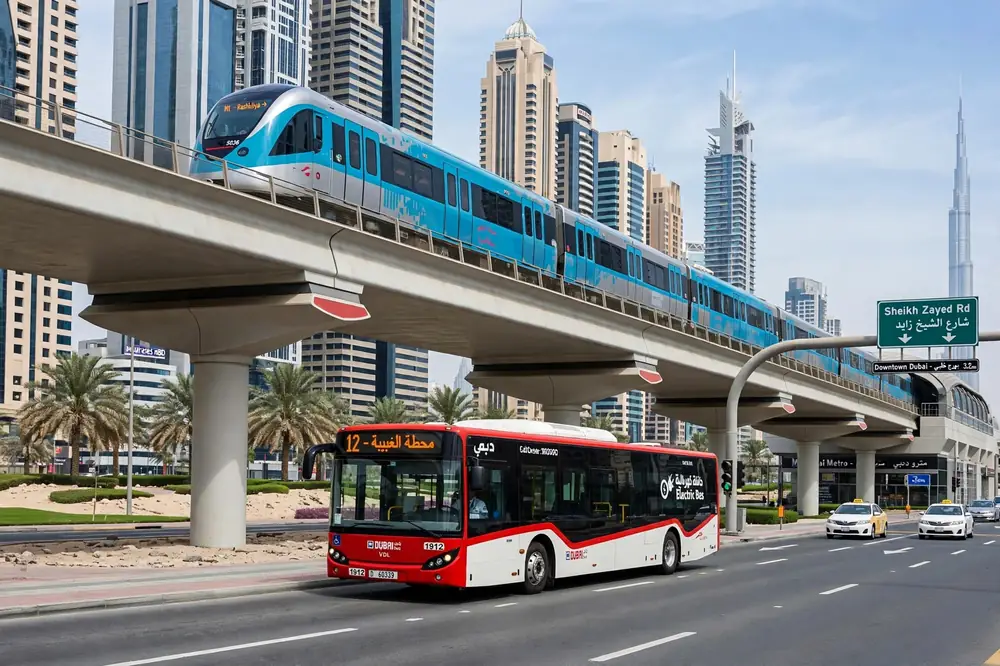
The Dubai Metro is the backbone of transport systems UAE travellers rely on. The Red Line runs from Centrepoint to UAE Exchange via Downtown Dubai, Dubai Marina, and Mall of the Emirates, while the Green Line serves Deira, Bur Dubai, and Dubai Healthcare City. Trains are driverless, air-conditioned, and run every few minutes during peak hours.
The Dubai Tram connects Dubai Marina, JBR, and Al Sufouh with the Metro at DMCC and Sobha Realty stations. Both metro and tram accept the Nol card, which you tap in and out at station gates. Cards come in Silver, Gold, Blue (personalised), and Red (single-trip) versions, and can be topped up at stations, machines, and online. Hotels in Business Bay are also close to Red Line stations.
Metro timings generally run from early morning until late at night, with extended hours on weekends and public holidays. Check the RTA app before travelling, as timings change during Ramadan and special events.
Buses & Intercity Travel in UAE — RTA, Abu Dhabi, Sharjah, Etihad Rail
Buses are the workhorse of public transport UAE travel. Dubai’s RTA buses cover the city with routes linked to metro stations. Abu Dhabi’s buses connect the Corniche, Yas Island, Saadiyat Island, and the airport, while Sharjah’s buses serve the city and industrial areas. Fares are paid with Nol or Hafilat cards.
For travel between emirates, intercity buses link Dubai with Abu Dhabi, Sharjah, Ajman, Ras Al Khaimah, and Fujairah. Services depart from hubs such as Al Ghubaiba, Union Square, and Abu Dhabi Central Bus Station.
Looking ahead, Etihad Rail will soon add passenger rail between major cities and support the wider logistics network of the country.
Taxis & Ride-Hailing in UAE — RTA taxis, Careem, Uber, Costs
Taxis are widely available across the UAE. Dubai’s RTA taxis can be hailed on the street, booked by phone, or requested through the Careem and RTA apps. Abu Dhabi and Sharjah run their own licensed taxi fleets with metered fares. Fares start with a fixed flagfall plus a per-kilometre charge.
Ride-hailing apps such as Careem and Uber operate in Dubai and Abu Dhabi, offering economy, premium, and family vehicle options. During peak hours and major events, expect surge pricing, so compare the app fare with a regular taxi before booking.
Driving & Car Rental in UAE — Licence, Rental, Parking, Salik
If you prefer to drive, the UAE has excellent roads and a large car rental market. Visitors can usually drive on an international driving permit or a licence from an approved country, while residents need a UAE driving licence.
Parking is paid in most commercial areas through meters, apps, or SMS. Dubai uses Salik toll gates on major highways, with each crossing charged automatically to a Salik tag. Fines for speeding, illegal parking, and toll violations are strict, so check traffic fines regularly, especially after a rental trip.
Transportation Costs in UAE — Approximate AED: Nol, Taxi, Rental, Fuel, Salik
Costs vary by emirate and distance, but these approximate figures help you budget:
- Dubai Metro and bus fares: around AED 3–7.50 per trip with a Nol card.
- Taxi fares: a flagfall of around AED 5–12 plus roughly AED 2 per kilometre.
- Ride-hailing: similar to taxis, with surge pricing during peak hours and events.
- Car rental: economy cars from around AED 80–150 per day.
- Salik toll: AED 4 per crossing at each Dubai toll gate.
For most residents, a Nol card plus occasional taxis costs far less than owning a car.
Tips for Getting Around UAE — Nol card, Apps, Peak hours, Plan routes
A few habits make every journey smoother:
- Top up your Nol card before you travel, and keep a spare balance for return trips.
- Use the RTA or Careem apps for live timings, fares, and route planning.
- Avoid peak hours (7–9 am and 5–8 pm) when possible, or allow extra time for traffic.
- If you are heading to a park, beach, or market, check the nearest metro or bus stop first.
FAQs
What is the best way to travel around the UAE?
For city travel, the Dubai Metro combined with buses is the fastest and cheapest option.
How do I get a Nol card?
You can buy a Nol card at any Dubai Metro station, bus station, or RTA service centre, and top it up at ticket machines or online.
What are the Dubai Metro timings?
The metro generally runs from early morning until late at night, with longer hours on weekends and public holidays. Check the RTA app before you travel.
Taxi or Careem — which is better?
Taxis are usually cheaper for short trips and easy to hail on the street. Careem and Uber offer upfront pricing, confirmed pickups, and larger vehicles.
Getting around the UAE is simple once you know the system. Start with the Dubai Metro and a topped-up Nol card, add buses for local trips, and use taxis or ride-hailing for door-to-door travel.