Drainage systems in UAE homes are easy to ignore until they fail. In the UAE, a blocked drain can turn a quiet villa street into a flooded road after one heavy downpour, and a slow drain inside the home can quickly become a bad smell, damp walls, or sewage backing up into a bathroom. With long dry spells, sudden rainstorms, sandy soil, and dense villa communities, drainage systems in the UAE face unusual stress. This guide explains the main types of drainage systems, how installation works for villas and buildings, the most common problems, cleaning and maintenance, and typical costs in Dubai and across the UAE.
Types of Drainage Systems in UAE
A drainage system carries wastewater and rainwater away from a property to a safe discharge point.
- Surface drainage — Channels and gratings that collect rainwater from driveways, courtyards, and roads. Blocked surface drains cause water to pool around villa entrances.
- Subsurface drainage — Perforated pipes below ground that lower the water table and protect foundations and basements from damp.
- Stormwater drainage — Larger pipes and manholes that move heavy rainwater from streets to municipal networks. Capacity matters most during the UAE’s short, intense rainstorms.
- Sewage and foul drainage — Sealed pipes carrying wastewater from toilets, kitchens, and bathrooms to a septic tank or municipal sewer. They must be airtight and vented.
- AC condensate drainage — Air conditioning units produce a trickle of condensate water. Clogged condensate lines leak through ceilings and walls.
- Landscape drainage — Garden beds and lawns need drainage that removes excess irrigation water without washing soil into nearby drains.
Drainage Installation for Villas & Buildings
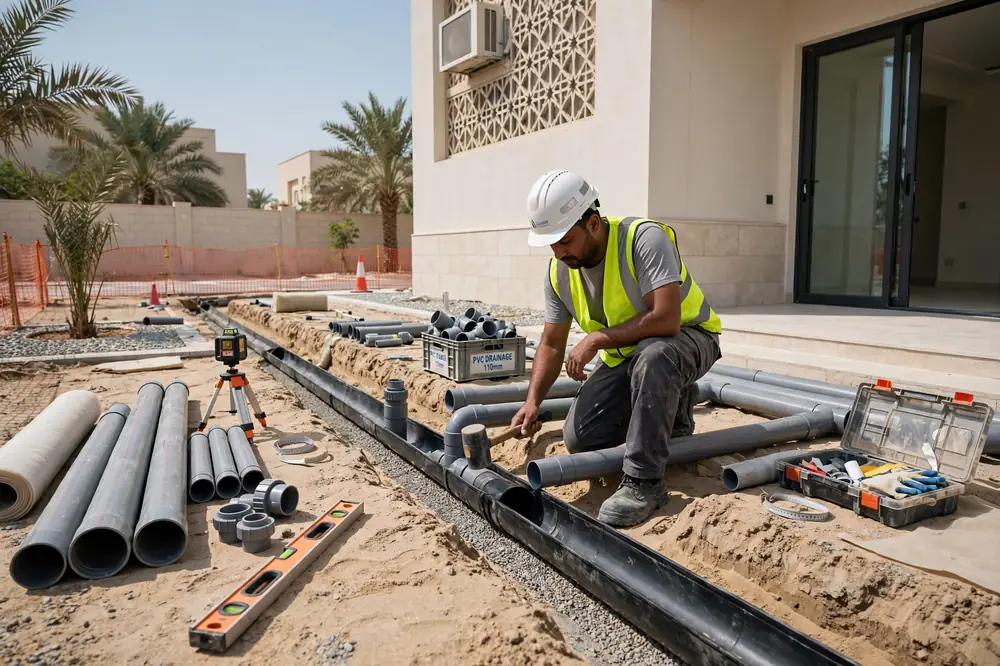
For a new villa, building, or major renovation, drainage installation in Dubai starts with planning, not digging. Design must match pipe sizes, slopes, and manhole positions to the plot, the number of bathrooms and kitchens, and local connection requirements.
- Planning and approvals — In Dubai and other emirates, drainage work usually needs approval from the local municipality or development authority. Drawings must show pipe routes, levels, manhole locations, and the connection point.
- Slope and levels — Drainage pipes rely on gravity. A fall of roughly 1:40 to 1:80 is common for household drains: enough slope to keep waste moving, but not so steep that water outruns solids.
- Pipes and bedding — uPVC pipes from reputable suppliers are standard for most villa drainage in the UAE because they resist corrosion and are easy to join. Pipes sit on compacted sand or fine gravel, with no sharp stones, and are surrounded by selected backfill.
- Manholes and inspection chambers — Access points go at every change of direction, junction, and at intervals along long runs. They allow cleaning and inspection when a blockage occurs, and covers must sit flush with finished ground levels.
Common Drainage Problems in UAE
Most drainage problems build up slowly, then appear suddenly after rain or heavy use.
- Blockages — Grease, food waste, wipes, and sand settle in pipes and narrow the flow. Kitchen drains are the most common blockage point in villas.
- Slow drains — Water that takes long to empty usually means a partial blockage or a venting problem.
- Bad smells — Dry traps, broken seals, or blocked vents let sewer gas into bathrooms and kitchens.
- Flooding — Overloaded storm drains or blocked surface channels can flood driveways, basements, and ground-floor rooms during storms.
- Root intrusion — Tree roots seek moisture and enter pipe joints, especially in older villas with mature gardens.
- Grease build-up — Kitchens that pour oil down the sink coat pipes with grease that hardens and shrinks the pipe opening.
Drainage Cleaning & Maintenance
Drainage cleaning in the UAE is far cheaper than emergency repairs. A good maintenance plan covers both inside and outside drains.
- High-pressure water jetting — Jetting scours grease, sand, and scale from pipe walls and clears blockages without chemicals.
- CCTV drain inspection — A small camera travels through the pipe and shows cracks, root intrusion, and collapsed sections on screen. It is the best way to diagnose repeat blockages before paying for excavation.
- Grease traps — Villas with large kitchens and food businesses should have grease traps cleaned on schedule. A full trap pushes grease into the main drain and causes blockages downstream.
- Maintenance schedule — For most villas, a drain check once a year is enough. Surface channels and gullies should be cleared before the rainy season.
Drainage Costs in UAE
Drainage cost in Dubai varies with access, pipe length, and property type. Figures below are approximate AED ranges.
- Drain cleaning for one line — AED 250 to 600
- High-pressure jetting — AED 500 to 1,500 per session
- CCTV drain survey — AED 400 to 1,200
- New drainage installation — AED 150 to 350 per metre for standard villa pipework, excluding major excavation
- Full villa drainage replacement — AED 8,000 to 30,000 or more, depending on plot size and complexity
Always get a written quote listing jetting, inspection, materials, and disposal separately, and ask whether municipality fees are included.
Tips to Prevent Blockages
Small habits prevent most blockages. Never pour cooking oil or grease down the sink — collect it in a container and bin it. Use drain covers to catch food scraps and hair, and clean them weekly. Flush only toilet paper, never wipes. Keep garden soil and leaves out of surface channels. For a stubborn slow drain, a local handyman service can clear traps and check vents before the problem grows.
FAQs
Why does my villa flood during rain?
Usually because surface drains or stormwater pipes are blocked or undersized, or the plot sits lower than the road.
How often should drains be cleaned?
Most villas need a full clean once a year, with surface channels cleared before the rainy season.
Who is responsible — the owner or the community?
Owners usually maintain drains inside their plot, while the community maintains roads and main lines. Check your community rules, or ask your property management company, for the exact boundary.
When is the best season to check drains?
Late summer, before the rainy season, so blockages and broken covers can be fixed in dry weather.
A well-planned drainage system, cleaned on schedule, protects your villa from flooding, smells, and costly repairs. Check your drains before the rainy season and fix small problems early.