On a construction skyline famous for its cranes, the rental market behind them rarely gets attention — yet almost every tower, warehouse and industrial lift in the Emirates depends on hired lifting equipment. Crane rental in UAE covers everything from a small truck crane for a half-day villa job to tower and crawler cranes committed to projects for years. This guide explains the crane types available, how to match capacity to a lift, how hire rates are built, the operator and permit rules that apply, and how to choose a rental company whose planning keeps lifts safe and on schedule.
Crane Types Available for Hire
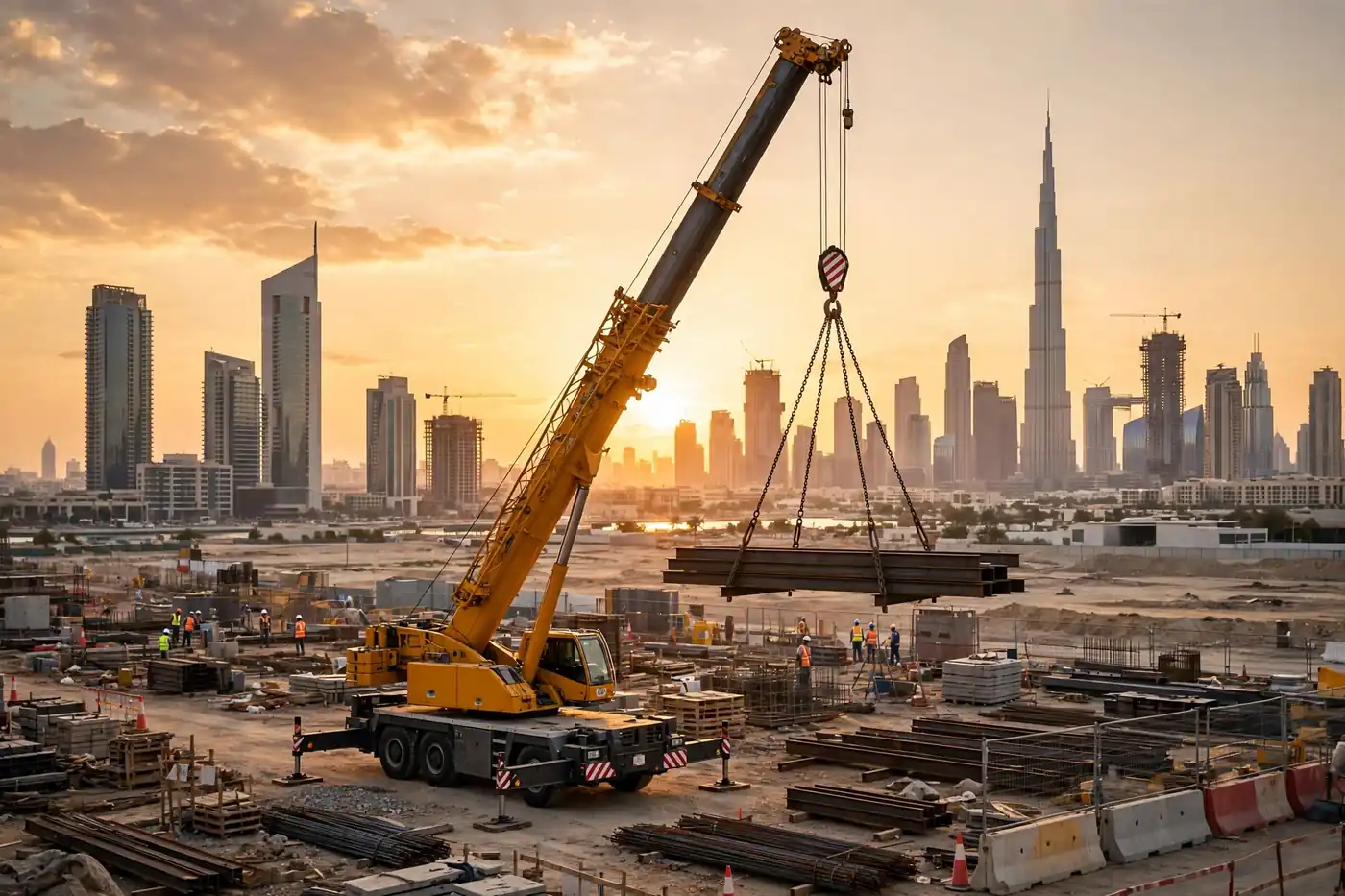
Mobile truck cranes are the rental fleet’s backbone: they drive to site, set up quickly and cover a wide capacity range, making them the default for day lifts, machinery installation and villa construction. Rough-terrain cranes serve unpaved sites, while all-terrain models combine road travel with serious lifting capacity. Loader cranes — the Hiab-style trucks — handle delivery-and-lift jobs where the same vehicle transports and places the load.
For long projects, tower cranes are erected on site and rented by the month or project, and crawler cranes handle the heaviest industrial and infrastructure lifts where loads and radii exceed mobile limits. The projects these machines serve are described in our guide to building construction in UAE, and the contractors who plan around them in our guide to civil engineering contractors in UAE.
Matching Capacity and Reach to the Lift
A crane’s headline capacity only applies at its shortest radius; as the boom extends and the load moves further from the crane, safe capacity falls steeply along the load chart. Honest planning therefore starts from the load’s true weight — including rigging — and the radius and height at which it must be placed, then selects a crane with comfortable margin rather than one at its limit.
Ground conditions decide as much as weight: outriggers need firm, level bearing, and soft or serviced ground may need mats or engineered pads. Overhead obstructions, neighbouring structures and the swing path all belong in the same conversation. Reputable rental companies send a planner to site for anything beyond a simple lift and produce a lift plan; treat any company willing to quote a heavy lift blind, from a phone description alone, as a warning rather than a bargain.
Smaller lifting jobs use the same market differently. A villa build may need a crane for an hour to lift a water tank, AC units or steel beams; a factory may book a day for a machine move. Rental desks handle these alongside project work, and minimum hire periods — often a few hours including travel — are the main cost driver at this scale. Combining several lifts into one visit, and having loads rigged and ready before the crane arrives, is how smaller customers keep these hires economical.
How Crane Hire Rates Work
Mobile cranes are typically hired by the hour with a minimum, by the day, or by the week for repeated work; tower cranes price by the month or project, including erection and dismantling. Rates are quoted with or without operator and fuel, and mobilisation — transporting the crane to and from site — is charged separately for larger machines, sometimes over long distances between emirates.
Your quote should state what happens with delays: standby charges when the load or site is not ready, overtime beyond agreed hours, and cancellation terms. Materials waiting to be lifted set the schedule pressure — our guide to building materials in UAE shows the delivery chains that crane time is booked around. As with all plant hire, the cheapest hourly rate loses its shine after one day lost to a breakdown or an undersized machine.
Operators, Certification and Permits
Cranes are supplied with certified operators, and both operator and machine carry third-party inspection certificates that site management will ask to see before the crane works. Riggers and banksmen complete the team for anything beyond simple lifts, with agreed signals and exclusion zones under loads. These are not formalities — on organised UAE sites, documentation is checked at the gate.
Lifts over public roads or outside site boundaries can need additional permissions and traffic management, and abnormal loads travelling to site follow their own rules. Your rental company should advise what applies to your lift and programme it into the schedule. Access work around the lift — platforms, scaffolding and edge protection — follows the standards in our guide to scaffolding accessories in UAE, and planning it together avoids the classic stand-off where the crane waits on access or the reverse.
Planning a Lift Safely
Safe lifts are boring lifts: a written plan, a briefed team, checked rigging, and weather limits respected — wind stops lifting work at defined speeds, and summer heat shapes shift patterns for crews. Loads are test-lifted just clear of the ground to confirm balance and weight before the real move, and tag lines control rotation. Nobody walks under a suspended load, ever, and the lift supervisor’s stop call is final regardless of programme pressure.
Maintenance underpins all of it. Ask how the company maintains its fleet and what happens if a crane fails mid-hire — the standard you want is the one described in our guide to heavy equipment repair in UAE: documented servicing, inspections on schedule and a replacement machine policy rather than apologies.
Scheduling discipline is the final practical point. Cranes are booked against other jobs all day, so a site that is not ready at the agreed hour may lose its slot entirely or pay standby while the machine waits. Confirm the booking the day before, have the lift area cleared and the load rigged, and keep one phone contact available throughout. Construction programmes slip for many reasons, but the contractors who get priority from rental fleets in busy weeks are the ones whose sites are ready when the crane rolls in.
Choosing a Crane Rental Company
Fleet age and breadth matter — a company with several cranes in each class can substitute when plans change, while a one-crane operator cannot. Check licensing, insurance and the certification paperwork before price, and ask for references from contractors with lifts similar to yours. Industrial clients with recurring needs often build frame agreements with the suppliers described in our guide to industrial machinery in UAE, and the same logic — proven reliability over headline rate — applies to one-off hires.
Finally, judge the planning conversation. The right company asks about load weight, radius, ground and access before it talks about price, and says no when a lift should not be attempted as described. In crane hire, that refusal is the sound of professionalism — choose the firm that protects your load, your site and its operator in that order, and the lift itself becomes the easy part.