
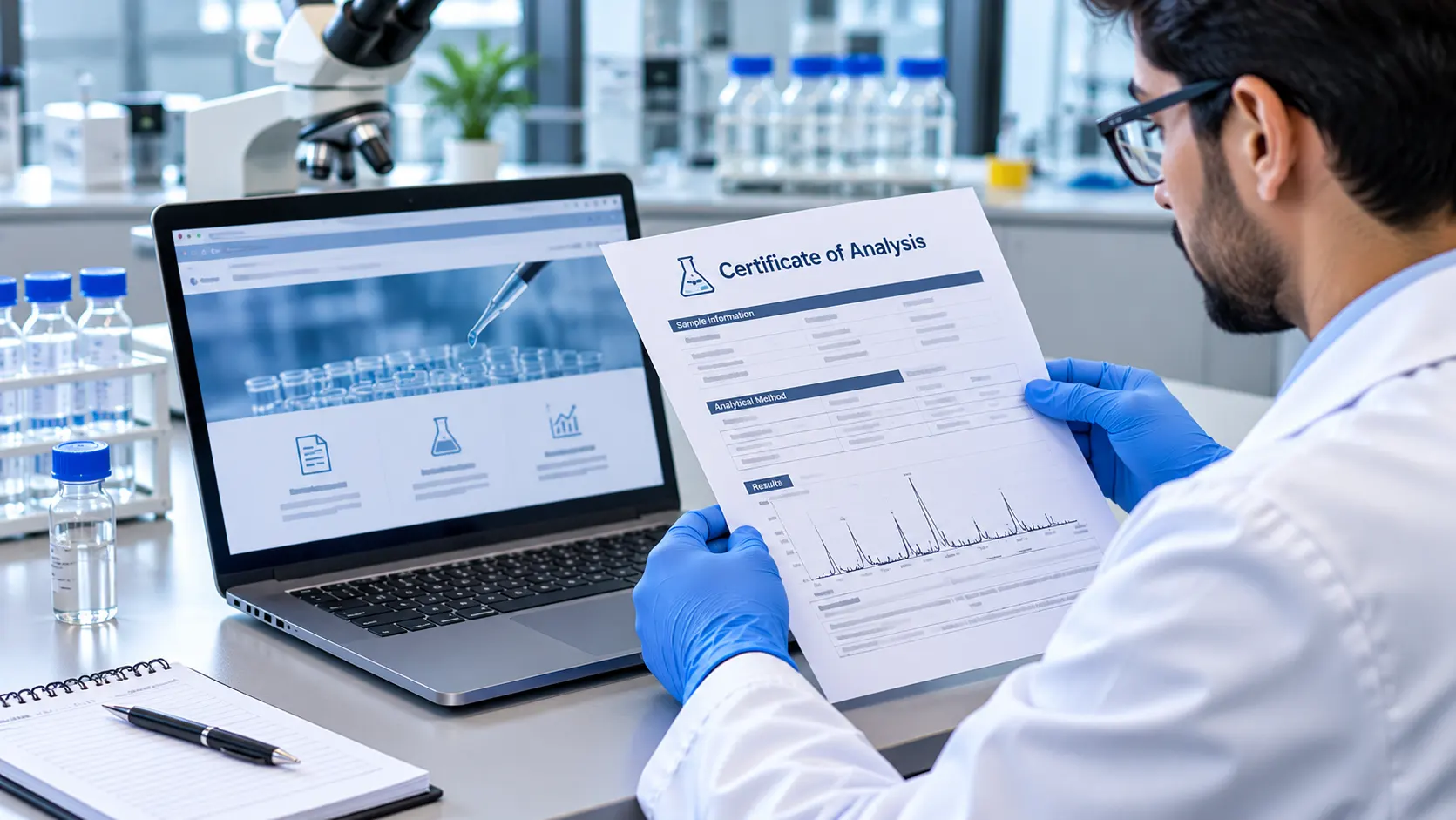
Laboratory documentation can provide useful information about a research sample, but a PDF or certificate should not be accepted without checking its source and details. A Certificate of Analysis (COA) may contain a laboratory name, report number, sample description, batch reference and analytical findings. However, these details need to be reviewed carefully to understand what was actually tested.
For research documentation, verification involves more than confirming that a report exists. The sample description, batch information, testing dates and reported results should also be consistent with the document being reviewed.
This guide explains how to check peptide COA reports online, understand common verification formats and recognise the limitations of laboratory records.
1. Start by Identifying the Laboratory and Report Reference
Before checking individual results, identify the laboratory named on the document. Look for the laboratory’s official name, website, report reference, testing date and sample information.
A report reference helps locate the corresponding laboratory record, where an online verification system is available. Check that the laboratory’s website and verification page belong to the organisation named on the report.
Do not rely only on a logo, screenshot or PDF supplied by a third party. These elements alone do not establish that a document is an original laboratory record.
It is also useful to distinguish between the laboratory that performed the analysis and the organisation that supplied or published the report. The name of a supplier or website on a product page does not necessarily identify the laboratory that conducted the test.
2. Use the Laboratory’s Official Verification System
Some laboratories provide online systems for checking whether a report corresponds to a record in their database.
For example, Janoshik provides an official verification page that uses two report identifiers:
- Task number: The reference assigned to the laboratory task.
- Unique key: The additional code used with the task number to retrieve the corresponding record.
To check a Janoshik report, visit Janoshik’s official verification page and enter the task number and unique key printed on the report.
After submitting the details, compare the returned laboratory record with the copy you received. Review the report reference, sample description, dates and reported findings rather than relying only on whether a result appears.
A successful verification confirms that the laboratory has a corresponding record for the sample it tested. It does not establish that a product currently being shipped, or another strength or format, comes from that tested sample.
Some product associations may be mapped by a supplier across different strengths or formats. Such mapping should not be presented as independent laboratory confirmation of every associated product or the current shipping lot.
3. Match the Report With the Correct Sample and Batch
Finding a matching online record is only one part of the review. The next step is to check whether the report describes the sample relevant to the research documentation.
Pay attention to the following details:
Sample name: Check whether the sample description matches the material identified in the document.
Batch or lot reference: Compare the batch information shown on the report with the batch reference being documented. If the report does not identify a batch, do not assume that it confirms one.
Testing dates: Review the dates when the sample was received and analysed, where these details are provided. They help establish the timeline of the laboratory record.
Sample description: Check whether the report identifies a specific sample, container or submitted material. Avoid treating a general product name as proof that every version of that product was tested.
A laboratory report applies to the sample submitted for analysis. It does not automatically establish the identity or characteristics of other batches, later production runs, different strengths or alternative formats.
This distinction is particularly important when reviewing supplier-mapped product associations. A report linked to one tested sample should not be described as confirmation of a separate sample unless the documentation supports that connection.
4. Understand Different Laboratory Verification Formats
Not every laboratory uses the same report structure or online verification process. The identifiers and records available depend on the laboratory that issued the document.
For example, Janoshik reports can use a task number and unique verification key to retrieve a corresponding online record.
METS Lab documentation may instead use report numbers, sample identifiers and original PDF records. Review the identifiers and verification information provided with the specific METS Lab document rather than assuming that it follows Janoshik’s task-number and unique-key process.
When reviewing either format, consider these questions:
- Is the laboratory clearly identified?
- Does the report contain a traceable reference or sample identifier?
- Is an original report or corresponding laboratory record available?
- Do the sample details and reported findings match the document being reviewed?
- Are the limits of the reported testing clearly understood?
If a laboratory does not provide a public verification tool, that does not automatically establish that a document is invalid. However, the available original documentation and identification details should be reviewed carefully, and any uncertainty should be stated rather than presented as confirmed authenticity.
5. Understand What Verification Can and Cannot Establish
A verified report is useful evidence of a laboratory record, but it should not be treated as proof of every characteristic associated with a product.
The findings apply to the sample and tests identified in that particular report. They do not automatically confirm other samples, batches, strengths or formats.
It is also important to distinguish between different types of analytical findings. For example, a result reported for one analytical method should not be interpreted as confirmation of tests that were not included in the report.
A document should not be used to make unsupported claims about sterility, safety, suitability for human or veterinary use, or other characteristics unless the relevant testing and evidence are specifically documented.
The same principle applies to published laboratory results. A report available through a research information website should be read within the scope of the original laboratory record. Publication does not expand what the laboratory actually tested.
6. Common Warning Signs During COA Review
Certain issues may indicate that a report needs further checking:
- Missing report identifiers: Important reference details are absent, making it difficult to trace the document.
- Inconsistent sample information: The sample name or batch details differ between the report and the associated documentation.
- Unmatched online records: The laboratory’s verification system returns information that does not correspond to the supplied report.
- Incomplete documents: Pages, results or identifying details appear to be missing.
- Unclear laboratory source: The issuing organisation cannot be clearly identified.
- Unsupported product associations: A report for one sample is presented as confirmation of other strengths, formats or current shipping lots without supporting evidence.
These points do not independently prove that a report has been altered or misrepresented. They indicate that the available documentation should be checked further before drawing conclusions.
7. Where to Review Published Laboratory Documentation
Research information platforms can help organise laboratory records and make available documentation easier to review.
Remy Research provides research-related information and access to published laboratory documentation. Its peptide lab reports can be used to review available records and their associated details.
When reviewing any published result, refer to the original laboratory document wherever available. Check the sample description, report identifiers, testing information and stated limitations.
A published report should not be interpreted as confirmation of a current shipping lot unless the documentation specifically establishes that connection. Similarly, a supplier-mapped association across different strengths or formats should remain clearly distinguished from an independently tested sample.
The purpose of reviewing these records is to understand the evidence available, not to assume that one report confirms every related product or claim.
Final Thoughts
Online COA verification is an important part of reviewing research laboratory documentation. Checking the issuing laboratory, using its official verification process where available, matching sample and batch details, and understanding the scope of the reported tests can help readers assess what a document actually establishes.
The most important distinction is between a genuine laboratory record and the broader claims that may be associated with it. A verified report relates to the sample tested and the findings recorded by the laboratory. It does not automatically confirm other batches, product formats or current shipping lots.
Careful documentation review should therefore focus on traceable records, accurate sample identification and clearly stated limitations.
Research-use notice: All information discussed in this article is intended for in-vitro laboratory research and documentation purposes only. It is not intended for human or veterinary use, administration, diagnosis or treatment.