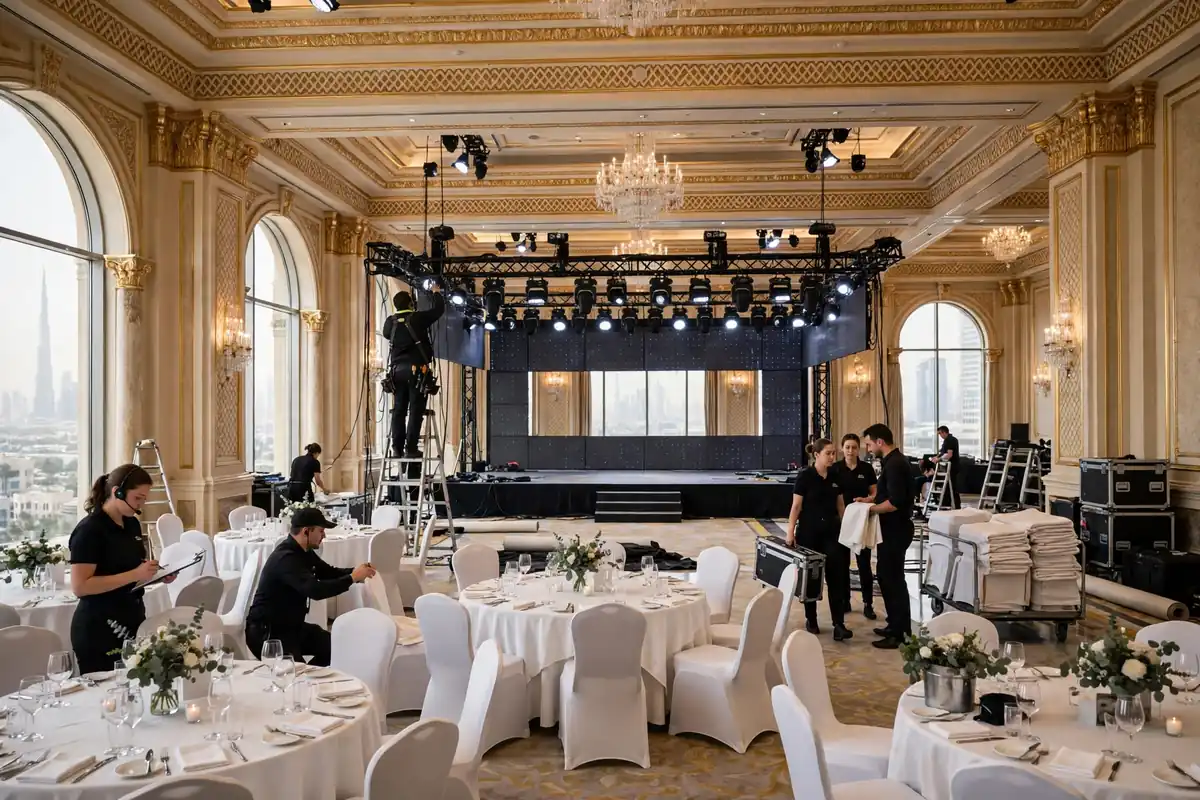
Few places host events like the Emirates. Dubai and Abu Dhabi run a year-round calendar of trade exhibitions, product launches, conferences, gala dinners and private celebrations, supported by venues and suppliers that operate at an international standard. Event management in UAE is the professional discipline behind those occasions: the planning, production, staffing and logistics that turn an idea into a room full of people having exactly the experience the host intended. This guide explains what event management companies actually do, the types of events they run, how budgets are built, and how to choose a partner for anything from a fifty-person workshop to a thousand-guest launch.
What an Event Management Company Actually Does
A full-service event company starts with the brief: the purpose of the event, the audience, the budget and the impression the host wants to leave. From there it builds the plan: venue selection and negotiation, event design and branding, audio-visual and staging production, catering coordination, entertainment booking, guest registration and staffing, plus the unglamorous essentials of permits, insurance, security and transport. On the day, the company’s producers run the schedule, cue the speakers and performers, and solve the inevitable problems before guests notice them.
Some clients use agencies for the whole journey; others bring them in for production only, keeping planning in-house. The value sits in supplier relationships and rehearsal discipline: an experienced team knows which venues load in efficiently, which AV suppliers deliver, and how long a ballroom turnaround really takes. Where the event is a wedding, the work overlaps heavily with dedicated planners, and our guide to wedding services in UAE covers that specialty in depth.
Types of Events Run in the Emirates
Corporate events dominate the calendar: conferences and summits, product launches, award ceremonies, staff parties, team-building days and exhibition stands at the big trade shows. Government and semi-government entities are major hosts, and their events carry protocol requirements that experienced local agencies understand well. Private events range from milestone birthdays and engagements to full-scale wedding weekends, often with international guest lists flying in.
Production expectations are high across all of them. LED walls, intelligent lighting and live streaming are standard at mid-size events, with suppliers such as the providers of giant LED screens booked months ahead in peak season. Exhibition work adds stand design and fabrication, where display designers build brand environments inside the big halls at Dubai World Trade Centre and ADNEC.
Venues, Permits and the Practical Rules
Venue choice drives everything else. Hotels offer ballrooms with in-house catering and experienced banqueting teams; our overview of hotels in Business Bay Dubai shows the style of property many corporate hosts use. Dedicated venues, beach clubs, desert camps, yachts and private villas each bring their own rules about access times, noise, power and catering. An event manager’s local knowledge shows in matching the venue to the format rather than forcing the format into a favourite room.
Permits are the part hosts most often underestimate. Public events, ticketed events, outdoor gatherings and events with entertainment or promotional activity can require approvals and licences through the relevant emirate’s authorities, and timelines for those approvals belong in the project plan from day one. Alcohol service, where relevant, is restricted to licensed venues, and Ramadan changes operating patterns for daytime events, entertainment and catering. A competent agency states these constraints early, in writing.
How Event Budgets Are Built
An event budget usually divides into venue and catering, production (staging, AV, lighting, branding), content and entertainment, staffing and logistics, and the agency’s management fee, which may be a flat fee or a percentage of spend. The honest way to compare proposals is a line-item budget against the same brief: two quotes that look far apart usually differ in production specification, staffing levels or what has quietly been excluded.
Keep a contingency line. Events generate late changes: extra guests, additional branding, a speaker flown in, weather cover for an outdoor element. Hosts who build contingency into the plan approve changes calmly; hosts who do not end up cutting quality on the day. Content capture is a line worth protecting too, because professional video production and photography extend the event’s value long after the room clears, and good photographers in the UAE book out early in the busy season.
Exhibitions, Hybrid Audiences and Peak Season
Trade exhibitions are a discipline of their own within event management here. Stand builds run to the venue’s technical regulations, rigging and power are booked through official contractors, and move-in schedules are measured in hours, so agencies that work the big shows keep dedicated exhibition teams. Since 2020, hybrid formats have stayed part of the landscape: conferences routinely stream sessions to remote audiences, which adds a broadcast production layer, platform management and a second audience experience to plan alongside the room. Peak season runs roughly from October to April, when the weather opens outdoor venues and the exhibition calendar fills; venues, production suppliers and senior event staff are booked months ahead in that window, and hosts planning a flagship event in those months should expect the good dates to go first.
Choosing an Event Management Partner
Review a portfolio for events like yours, not just the biggest logos. Ask who will produce your event on site, how the team handles a supplier failure, and what their largest logistical challenge was on a recent job. References from venues and repeat clients are a strong signal in a market where the best agencies are rebooked quietly. Get the proposal in writing with scope, deliverables, payment schedule and cancellation terms.
Event management in UAE rewards early booking and clear briefs. Give a good agency a defined budget, an honest guest profile and time to plan, and the result is an event that feels effortless precisely because none of it was.